Adaptive Manufacturing: From Fixed Systems to Flexible Intelligence
#Industry40 #PhysicalAI #SmartManufacturing #IndustrialAI #AutomotiveManufacturing #AdaptiveManufacturing #FlexibleAutomation #RoboticsAndAutomation
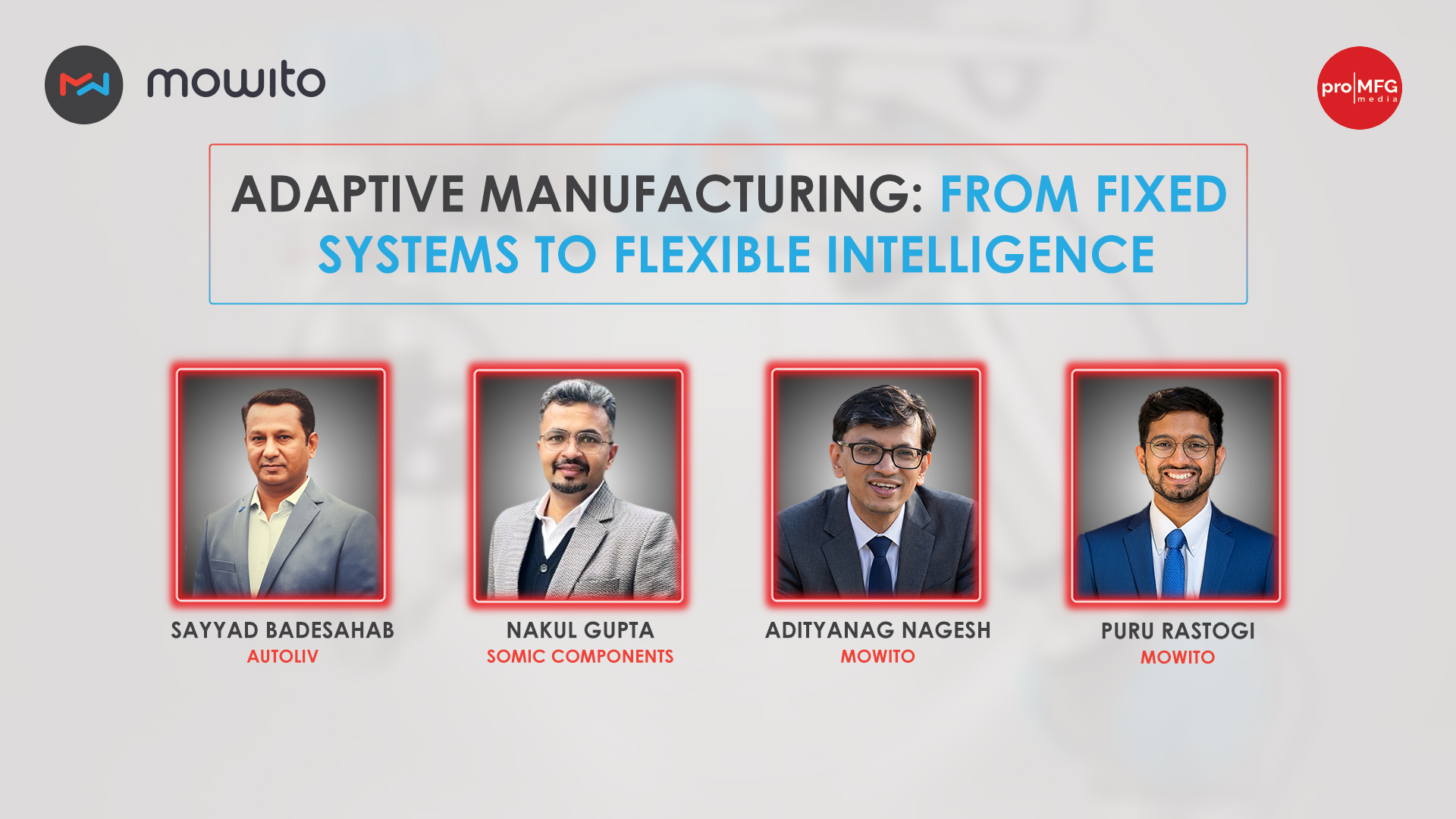
January 2026 : Automotive components manufacturing leaders gathered recently, for a high-impact virtual roundtable hosted by Mowito Robotics and curated by Pro MFG Media. The discussion zeroed in on transforming rigid production lines into flexible, AI-enabled systems to handle surging product variants and demand volatility. As high-mix production challenges intensify, retrofit-ready "physical AI" solutions prove effective in brownfield plants.
The session featured experts:
● Nakul Gupta, SOMIC Components
● Sayyad Badesahab, Autoliv India
● Adityanag Nagesh, Co-founder, Mowito Robotics
● Puru Rastogi, Co-founder, Mowito
The session was moderated by Manish Kulkarni, Co-Founder & Director, Pro MFG Media. Their dialogue cut through hype to reveal practical paths forward.
Nakul Gupta from SOMIC ZF Components kicked off by highlighting the point. "Our manufacturing facilities cannot be rigid. Low volumes with a high number of models and variants are forcing us to shift towards a flexible system."
Panelists agreed: surging customization, from EV battery trays to ADAS sensors, demands lines that adapt without halting production.
Unpacking the Three Big Flexibility Barriers
Beyond tech, hardware rigidity locks fixtures, poka-yokes, and conveyors into single geometries, leading to lengthy changeovers. Operators face skills shortages in reconfiguring robots and dealing with diverse PLC brands which disrupts seamless integration and leaves plants dependent on specialists.
Sayyad Badesahab from Autoliv captured it sharply: "The biggest gap in flexibility is not the technology itself, but the way lines are designed today. They are built for one volume and one set of parts, then become prisoners of that design."
Mowito demonstrated how robots learn via operator demonstrations. Guide the arm 10 to 15 times, let sensors capture data, and AI models run autonomously. These systems "follow the part" using vision and force feedback, ditching fixture dependency for variant handling.
Adityanag Nagesh explained: "We are teaching old robots new tricks by adding eyes and tactile sensing, so they can follow the part instead of forcing the part to follow the fixture."
AI vision fixes chronic QR code reads, while robot-agnostic software bridges legacy PLCs. This echoes welding automation's journey from ROI doubts to industry standard.
Puru Rastogi added: "In many brownfield plants, the right question is not 'Can we rebuild the line?' but 'Can we drop in a robot that learns the job like an operator and works with all the imperfections of the real world?'"
Redefining ROI in the Adaptive Era
Panelists pushed beyond labor savings to holistic metrics: slashed changeovers, quality leaps, and freedom from specialists. Adaptive setups extend line life across model cycles.
Sayyad Badesahab emphasized: "Everything starts with ROI, but the real KPIs are long-term value, quality, competitiveness, and how much we can reduce our dependence on specialists."
The roundtable sparked lively exchanges with Adityanag Nagesh closing powerfully: "The fear that AI might fail will fade as manufacturers see their own plant data making these systems more robust than fixed logic ever could."
This shift to physical AI isn't just tech. It's a blueprint for resilience in volatile markets.

NEWSLETTER
TRENDING ON PRO MFG

MORE FROM THE SECTION