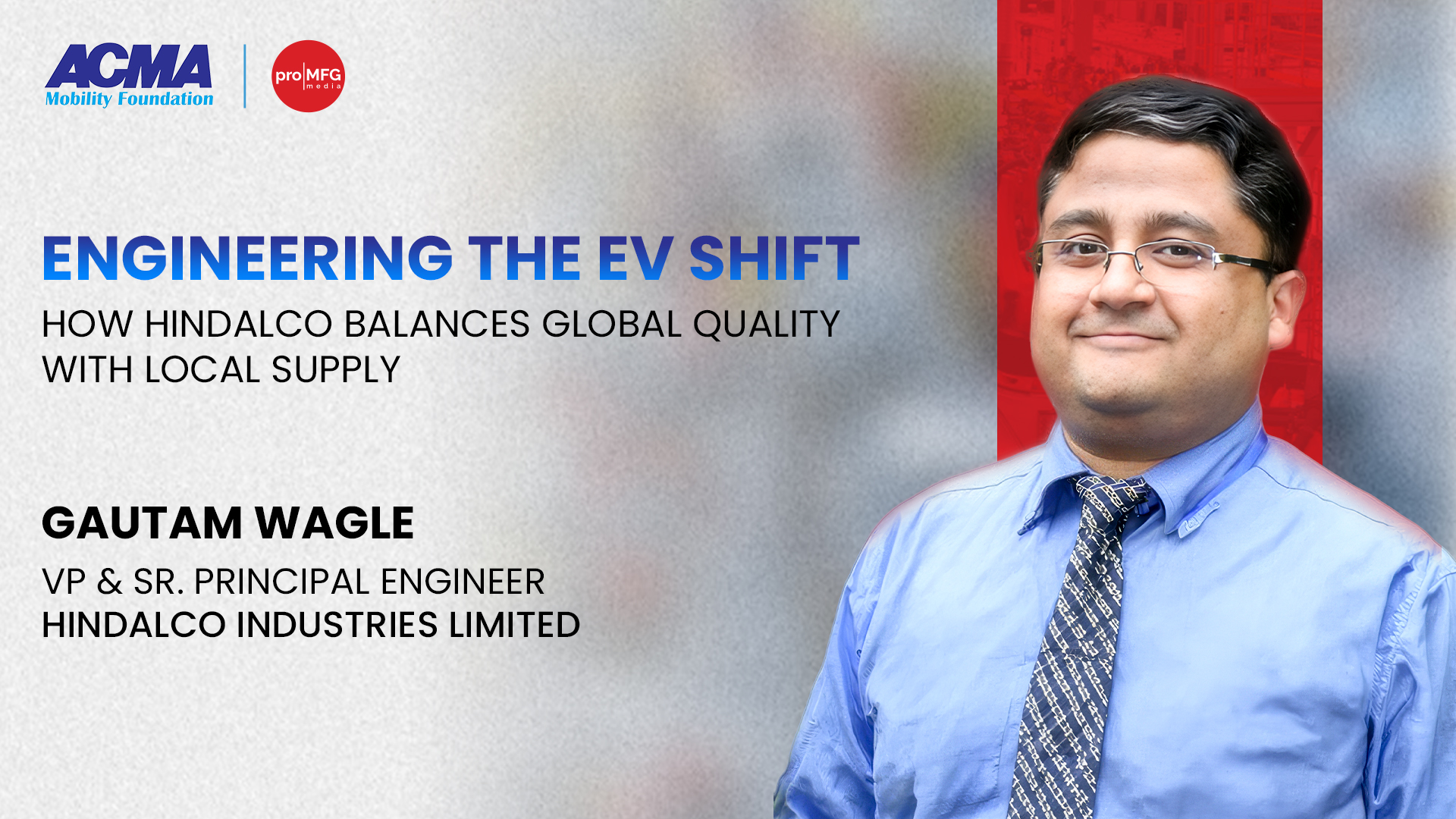
Engineering the EV Shift: How Hindalco Balances Global Quality with Local Supply
#DigitalTransformation #ProMFGMedia #SmartManufacturing #FutureOfMobility #AutomotiveInnovation #SustainableManufacturing #Industry40 #AutomotiveLeadership #EVIndia #ACMAThinkTurf2026"The moment you digitize, you realize what you were missing. Quality data doesn't just improve efficiency - it reveals the hidden losses you never knew existed." - Gautam Wagle, VP & Sr. Principal Engineer, Hindalco Industries Limited
September 2026 : It’s an eye-opening moment for any shop floor manager: you connect an "isolated" production line to online digital monitoring for the first time, only to watch your overall equipment effectiveness (OEE) drop by 14%.
Why? Because manual tracking almost always misses the tiny, recurring micro-stoppages that silently bleed plant productivity.
At the 4th Edition of the ACMA Automotive Smart Manufacturing Think Turf 2026 powered by Pro MFG Media, industry thought leaders gathered around the theme Transforming Mobility: Innovation, Integration, and Impact.
In a standout panel titled "Gears of Automotive Growth: Resilient, Automated & Intelligent Manufacturing," Gautam Wagle, VP & Sr. Principal Engineer at Hindalco Industries Limited discusses how real-time data, advanced metallurgy, and local supply chain integration are driving India's automotive transformation.
Here are the critical takeaways from his perspective on bridging shop-floor data with lightweight material innovation.
1. Digital Honesty: The Real Power of IoT Data
"When we implemented IoT on a small line, our monitored OEE actually dropped by 14%," Wagle revealed. While that might sound like a setback, it was actually a victory for operational clarity.
Before smart sensors were installed, small daily losses were simply getting lost in manual logs. Intelligent manufacturing provides data accuracy that forces real accountability. Once you see the true, unvarnished picture of shop-floor performance, you can target root causes instead of fighting symptoms.
2. EV Battery Housings & The Localization Imperative
With India's electric vehicle (EV) momentum accelerating across two-wheelers, passenger cars, and commercial fleets, the demand for high-strength, lightweight aluminum has surged. But designing for EVs presents a unique engineering challenge: battery safety standards cannot be compromised.
"These standards are not evolving as we go; they are meant to be global right from day one," Wagle explained.
To meet strict international safety, thermal protection, and structural integrity norms, Hindalco leverages a 100% domestic supply chain - from bauxite mines in India to finished rolled aluminum products. By partnering directly with OEM development teams and Tier-1 suppliers, they align intrinsic material specifications, alloy behavior, and joining capabilities early in the design cycle.
3. Commercial Vehicles: Finding the Tipping Point for Aluminum
In the commercial vehicle (CV) space, switching from heavy steel containers to aluminum can boost payload capacity by up to 2.5 tons. So why hasn't the entire industry converted overnight?
It comes down to scale, width constraints, and heat-treatment assets.
While Hindalco has successfully prototyped aluminum bulkers, tankers, and smart containers, widespread adoption requires balancing local manufacturing scale with capital investment. To bridge this gap, Hindalco collaborates with its global subsidiary, Novelis, to supply specialized alloys and high-width sheets while building out the necessary heat-treatment capacity locally in India.
"It's a multi-phase approach," noted Wagle. "We leverage global capabilities to develop the market today, and as scale builds, we invest in the local domestic assets."
4. Accelerating R&D with Simulation-Driven Tools
How do you shorten the innovation cycle without running up massive costs on trial-and-error shop floor experiments? Wagle's team relies heavily on simulation-driven engineering.
By simulating alloy performance, structural stress, and manufacturing processes like joining in virtual environments, Hindalco achieves "first-time-right" material development. They take on the burden of building and testing prototypes themselves - proving performance to conservative automotive clients before touching a full-scale assembly line.
From uncovering hidden shop-floor losses to producing world-class aluminum alloys for EV platforms, Hindalco’s blueprint proves that smart manufacturing isn't just about software - it’s about grounding digital insight in deep material science and robust domestic supply chains.

NEWSLETTER
TRENDING ON PRO MFG
MORE FROM THE SECTION