From Dashboards to Autonomous Action: Reimagining Indian Auto Manufacturing
#DigitalTransformation #ProMFGMedia #SmartManufacturing #FutureOfMobility #AutomotiveInnovation #SustainableManufacturing #Industry40 #AutomotiveLeadership #EVIndia #ACMAThinkTurf2026"Digital transformation isn’t about tech for tech’s sake - it’s about knowing which business problems to solve and having the courage to let fresh thinking lead the way." - Viswanathan A, President, Delphi TVS
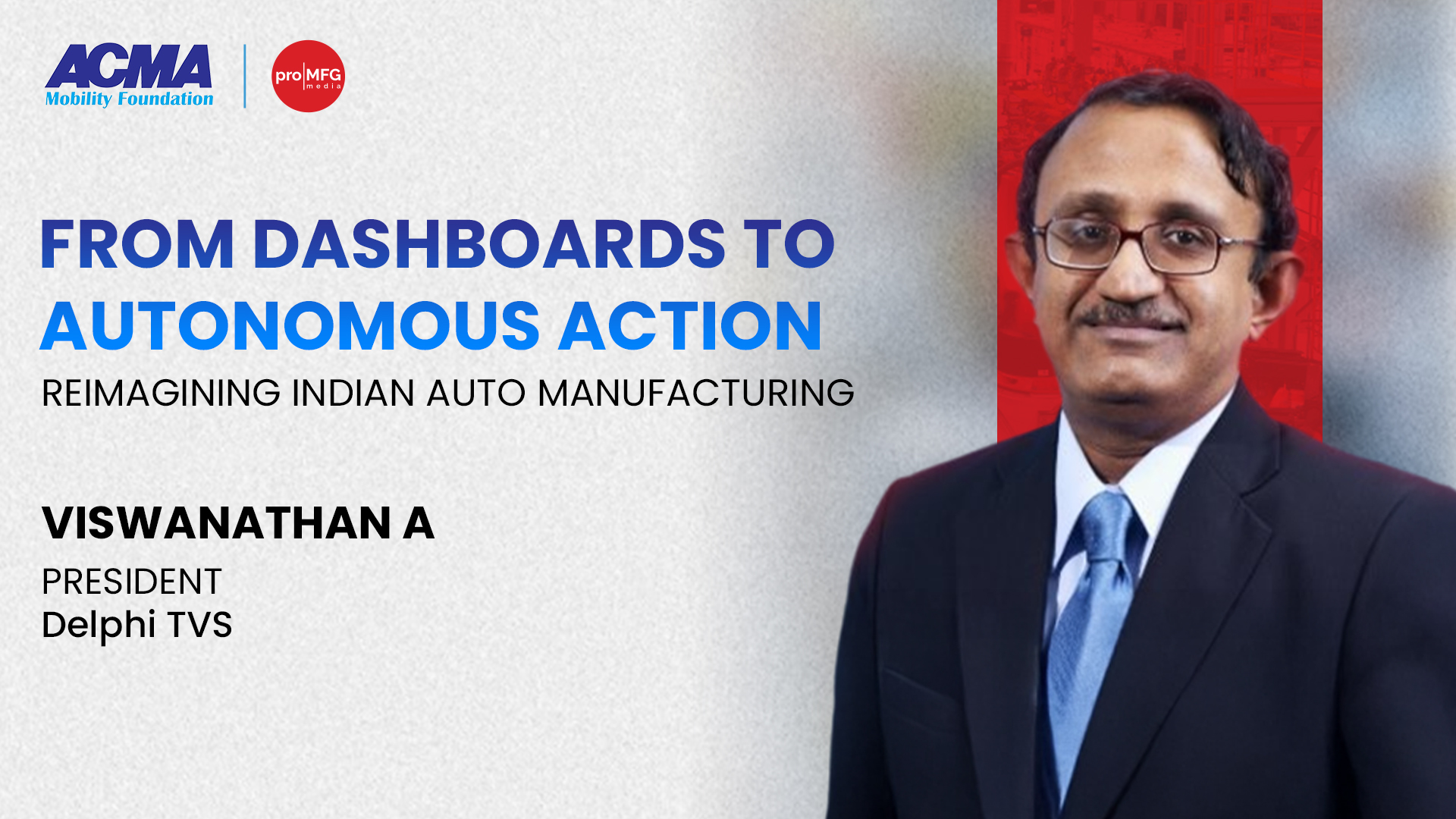
October 2026 : The shop floor isn’t what it used to be. Standing in a modern auto plant, you won't just hear the rhythmic clatter of assembly lines - you’ll feel the quiet, hyper-efficient intelligence of network-connected systems predicting maintenance needs before a machine even stutters.
At the 4th Edition of the ACMA Automotive Smart Manufacturing Think Turf 2026 powered by Pro MFG Media, industry leaders gathered under a compelling theme: Transforming Mobility: Innovation, Integration, and Impact.
Among the standout discussions was the panel on "Gears of Automotive Growth: Resilient, Automated & Intelligent Manufacturing." Viswanathan A, President of Delphi TVS unpacked what "intelligent manufacturing" actually looks like from the corner office - and how India’s auto component sector can lead the world stage.
Here are the three big takeaways from their conversation on building shop floors that are resilient, scalable, and genuinely smart.
1. From Control Rooms to Autonomous Action
Reflecting on his early career in the petrochemical sector 35 years ago, Viswanathan recalled being mesmerized by Distributed Digital Control Systems (DDCS) - single control hubs where engineers could monitor flows, toggle valves, and maintain safety across an entire facility.
"When I entered the automotive industry three decades ago, I kept asking myself why we couldn't have that same real-time visibility," he shared.
Fast forward to today, and automotive tech has caught up - and then some. But true intelligence isn't just about streaming data onto shiny dashboards; it's about progressing from data visibility to autonomous action.
The key for leadership? Avoid the trap of digital vanity projects.
"It’s not just digital or AI for the sake of it," Viswanathan emphasized. "You need to see returns. You have to pick and choose which business problems make sense to solve with digital solutions."
2. Localization Without Compromise
As supply chains face global volatility, "de-risking" through local sourcing has become imperative. But localizing critical components often raises a tricky question: How do you scale local vendors without sacrificing global quality standards?
Viswanathan’s answer is simple: It isn't an "either/or" - it's a "must-have both."
Rather than making abrupt cuts from overseas suppliers, Delphi TVS builds hand-in-glove partnerships with domestic vendors:
- • Tech Transfer & Support: Deploying engineers directly to vendor sites to establish quality control.
- • Risk Mitigation: Structuring inventory buffers during launch phases.
- • Phased Transition: Gradually ramping down import reliance as local capability matures over time.
This gradual, high-touch approach ensures local suppliers reach top-tier quality standards while keeping production lines immune to sudden shocks.
3. The Innovation Engine: 20-Somethings + 40-Somethings
How do you break down internal silos across R&D, engineering, and shop-floor operations? According to Viswanathan, accelerating innovation requires confronting two main barriers: fear of failure and departmental territorialism.
His proven formula? Autonomous cross-functional teams with a deliberate generational mix:
Ideal Innovation Team = High Proportion of 20s (Audacity) + Seasoned 40-50s (Sanity)
"Put a mix of people in their 20s and people in their 40s or 50s - with the younger team members making up the larger proportion," he advised. The energy and digital fluency of early-career engineers combined with the strategic guardrails of seasoned managers creates a culture where sensible risks get taken - and fast.
As Indian manufacturing cements its position in the global automotive ecosystem, moving past endless pilot projects into scaled, intelligent platforms is no longer optional. By focusing on measurable ROI, nurturing local supply networks, and empowering cross-generational teams, the sector isn't just adapting to the future - it's building it.

NEWSLETTER
TRENDING ON PRO MFG


MORE FROM THE SECTION