The Race to Market: Building the Agile Foundations of Modern Automotive Production
#SmartManufacturing2026 #ProMFGMedia #RockwellAutomation #TimeToMarket #AgileManufacturingEnterprise #DigitalTransformation #ITOTConvergence #AutomotiveIndia #SmartFactory #IndustrialConsulting“The factories that win tomorrow will not be those that simply buy the most advanced tools, but those that build a self-funding digital nervous system to out-pace the market.”
June 2026 : In the modern industrial landscape, a silent but profound shift has occurred. The defining hurdles of automotive manufacturing are no longer fundamentally about engineering - we know how to build world-class vehicles. Instead, the real challenge lies in organizational agility: the speed at which an enterprise can make decisions, pivot production lines, and compress the journey from a designer's concept to a customer's driveway.
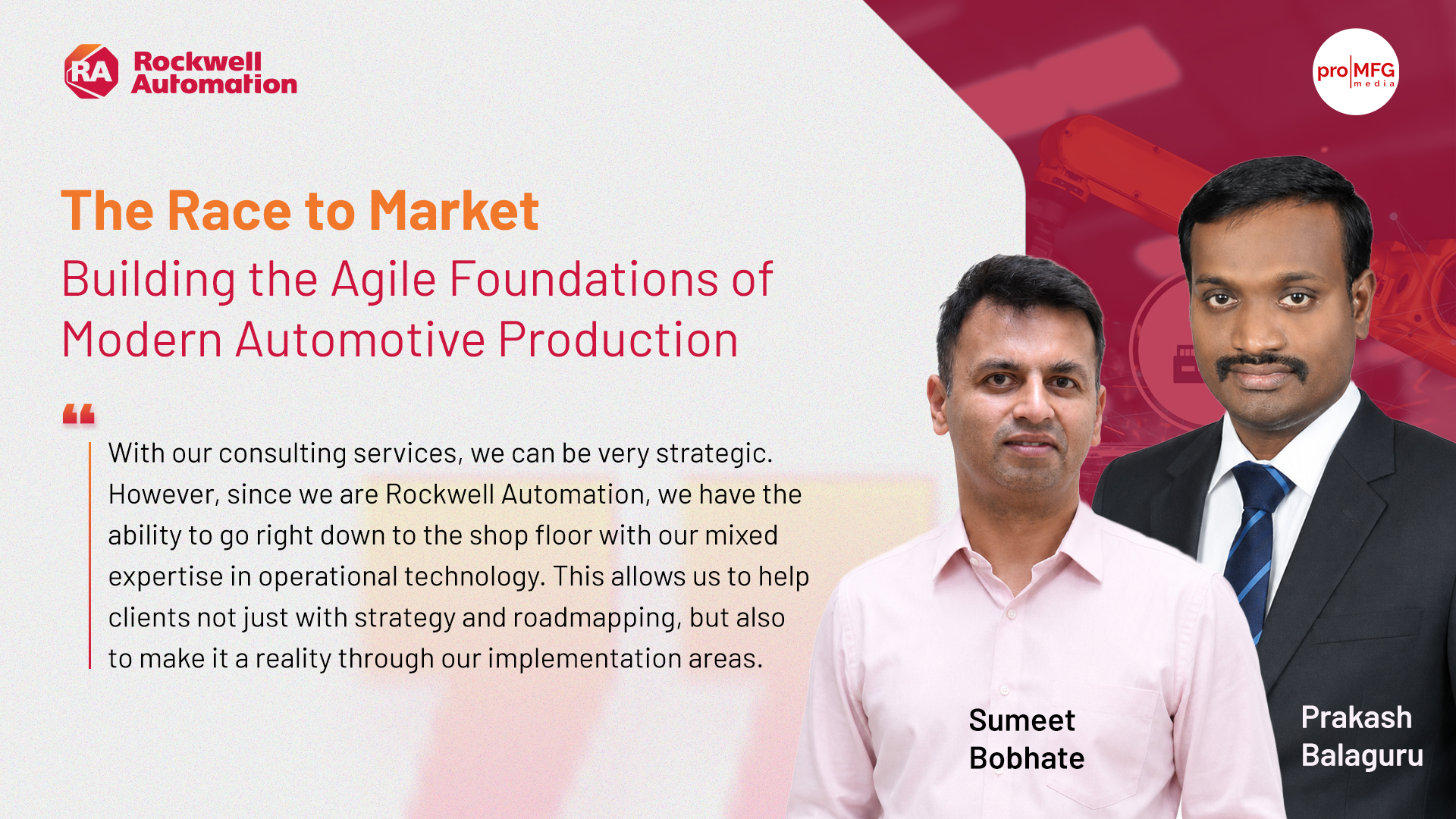
At Rockwell Automation's Smart Manufacturing Automotive Summit 2026, powered by Pro MFG Media, this reality took center stage. In a compelling joint session focused on accelerating time-to-market, Rockwell Automation’s Prakash Balaguru and Sumeet Bobhate pulled back the curtain on what it takes to build a future-ready manufacturing enterprise. Their message was practical and urgent: in an era disrupted by legacy data silos and manual friction, true transformation requires a consulting-led approach that seamlessly bridges corporate strategy with shop-floor execution.
The automotive sector is currently navigating five seismic market shifts that make operational flexibility a matter of survival:
From Mass Production to Mass Customization: Consumers no longer want carbon-copy vehicles; hyper-customization demands highly flexible manufacturing systems and rapid, zero-downtime changeovers.
The Software-Defined EV Transition: New electric vehicle architectures and evolving battery technologies demand rapid adaptability and entirely new supplier networks.
Shorter Product Life Cycles: Rapid vehicle upgrades require modular production lines, virtual validation, and a continuous flow of digital data.
Complex ESG Compliance: Tighter emission and safety mandates require absolute traceability and data-driven architectures built inherently into daily operations.
Supply Chain Volatility: Fluctuating material availability demands real-time plant floor visibility so factories can dynamically adapt without delaying vehicle launches.
To survive these pressures, factories must deploy an internal "digital central nervous system" powered by Manufacturing Execution Systems (MES) and parallel engineering. By validating layouts virtually through digital twins before physical implementation, manufacturers can run product design and production planning concurrently - shaving months off development timelines.
However, a digital nervous system is only as good as the data feeding it. True agility is impossible when Information Technology (IT) networks in the front office remain completely isolated from the Operational Technology (OT) controlling the machines on the shop floor. Breaking down these historic corporate silos is the absolute baseline of smart manufacturing. True IT/OT convergence ensures that the right data reaches the right person at the exact right time, shifting plant-floor management from defensive, reactive firefighting to real-time, optimized decision-making.
Recognizing that many manufacturers struggle with where to begin, Balaguru and Bobhate highlighted Rockwell’s Digital Value Accelerator (DVA). This tailored consulting service is designed to help enterprises map out high-value use cases and secure long-term ROI through a disciplined, three-stage process:
1. Evaluate: Deeply analyze corporate goals, build hypotheses, and interview stakeholders to uncover hidden operational friction.
2. Plan: Prioritize high-value digital use cases and map out a future-state Industry 4.0 architecture to secure leadership alignment.
3. Mobilize: Deliver an actionable IT/OT convergence model, change-management designs, and a clear execution roadmap.
A standout philosophy of the DVA approach is its focus on creating a self-funding roadmap. Instead of demanding massive, multi-year capital expenditure upfront, the strategy leverages an "MVP (Minimum Viable Product) to scale" methodology. Early, high-impact projects are designed to deliver clear value quickly - typically within 90 to 100 days - and the ROI generated from those early wins directly funds subsequent digital initiatives.
Ultimately, the session underscored why a balanced approach matters. While traditional strategy consulting firms often stop at the boardroom door, and standalone system integrators focus only on isolated technical fixes, the future belongs to those who can unify both. By pairing strategic business acumen with deep, hands-on OT expertise, automotive leaders can confidently build an ecosystem that is fast, resilient, and built to scale.

NEWSLETTER
TRENDING ON PRO MFG



MORE FROM THE SECTION