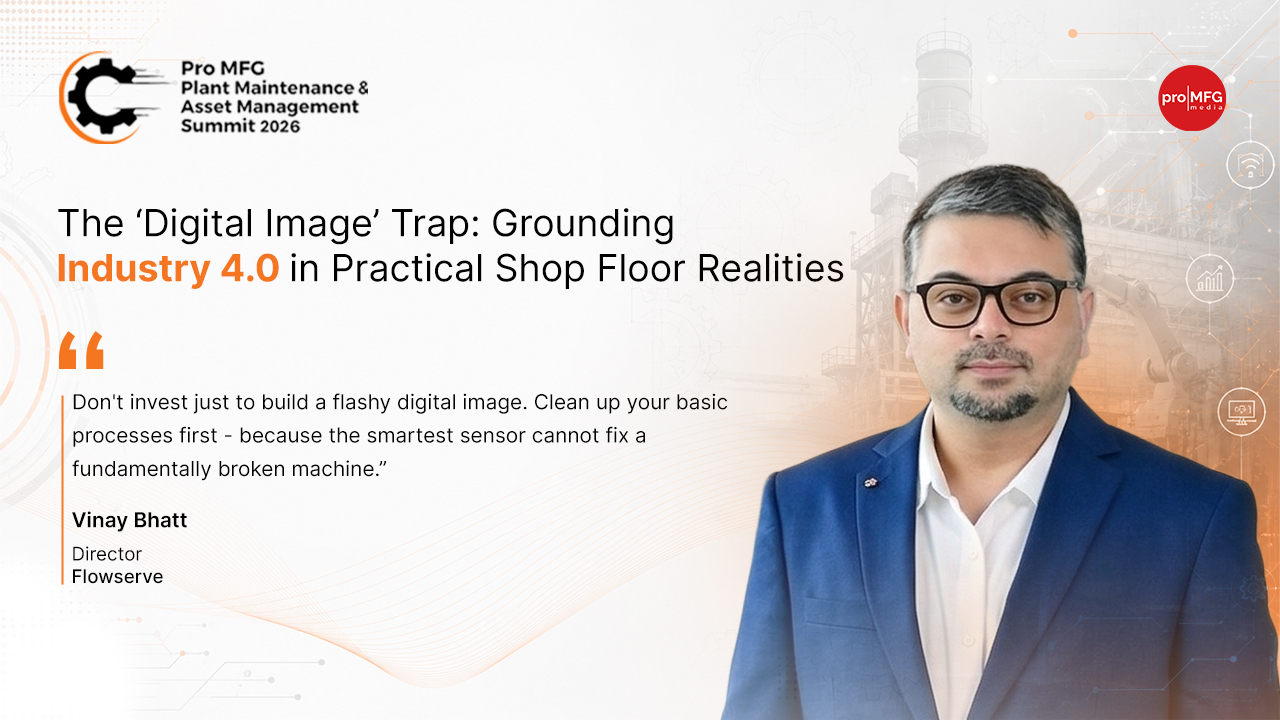
The ‘Digital Image’ Trap: Grounding Industry 4.0 in Practical Shop Floor Realities
#ProMFG2026 #PMAMSummit #SmartMaintenance #PlantOperations #ReliabilityEngineering #IndustrialIoT #AssetManagement #OEEOptimization"Don't invest just to build a flashy digital image. Clean up your basic processes first - because the smartest sensor cannot fix a fundamentally broken machine." - Vinay Bhatt, Director, Flowserve
June 2026 : We live in a manufacturing landscape infatuated with terms like Industry 4.0, cloud computing, and the Industrial Internet of Things (IIoT). Walking the floor of a modern factory, it is easy to assume that a facility's intelligence is directly tied to the number of digital dashboards lighting up the control room. However, true reliability is rarely born out of flashing lights and expensive software updates.
This pragmatic perspective anchored the panel at the 7th Edition of the Pro MFG Plant Maintenance & Asset Management (PMAM) Summit 2026 in Coimbatore. Hosted by Pro MFG Media alongside Presenting Partner Mobil and Gold Partner ImageGraphix, the forum focused on Smart Maintenance - Leveraging Digital Tools for Reliable Plant Operations.
Stepping up to ground the conversation was Vinay Bhatt, Director at Flowserve. Drawing from over a decade of running heavy-duty plants producing critical industrial pumps, Bhatt delivered a sharp message: before chasing a "digital image," factories must master their fundamental engineering.
Bhatt highlighted the steep, practical challenges of modernizing industrial plants. It isn't as simple as plugging in a new device; it requires overcoming a double-layered legacy gap involving both machines and mindset. "The machines are old, the people are old, and the thinking is traditional," Bhatt explained. This creates an immediate friction point. Legacy machinery doesn't speak a digital language natively, necessitating physical retrofitting before smart communication is even possible. Simultaneously, shop floor teams often lack the advanced digital skillset required to navigate complex IoT systems.
To illustrate how elegant simplicity can beat high-tech systems, Bhatt referenced a century-old dam in India. Built without a single motor, gearbox, or computerized sensor, its gates operate on purely automatic hydrostatic balance - opening when water rises and closing as it drops. This historic, mechanical masterpiece serves as a reminder that highly effective, automatic systems don't require overly complex setups to function reliably.
Bhatt also shed light on an emerging friction point between original equipment manufacturers (OEMs) and heavy industrial operators. Rotating equipment like pumps serve as the functional "heart" of critical infrastructure - running continuously inside refineries and petrochemical plants for decades.
Flowserve looks to equip these pumps with IoT tracking to offer proactive, predictive maintenance to its buyers. However, they run directly into a strict wall of cybersecurity protocols.
"Refineries and petrochemical plants frequently refuse to allow their equipment data to be sent to a shared cloud or external server," Bhatt noted. "To them, operational data is highly confidential information." While mindsets are slowly adapting, this data-sharing gridlock remains a significant barrier to scaling cross-enterprise predictive maintenance.
Ultimately, Bhatt offered a clarifying metric for managing maintenance expenditures and aligning with executive leadership. The goal shouldn't be a fixed annual allocation. Instead, true smart maintenance should deliver a steady, year-over-year decrease in overall spending - proving that strategic investments today are successfully engineering failures out of tomorrow.

NEWSLETTER
TRENDING ON PRO MFG



MORE FROM THE SECTION