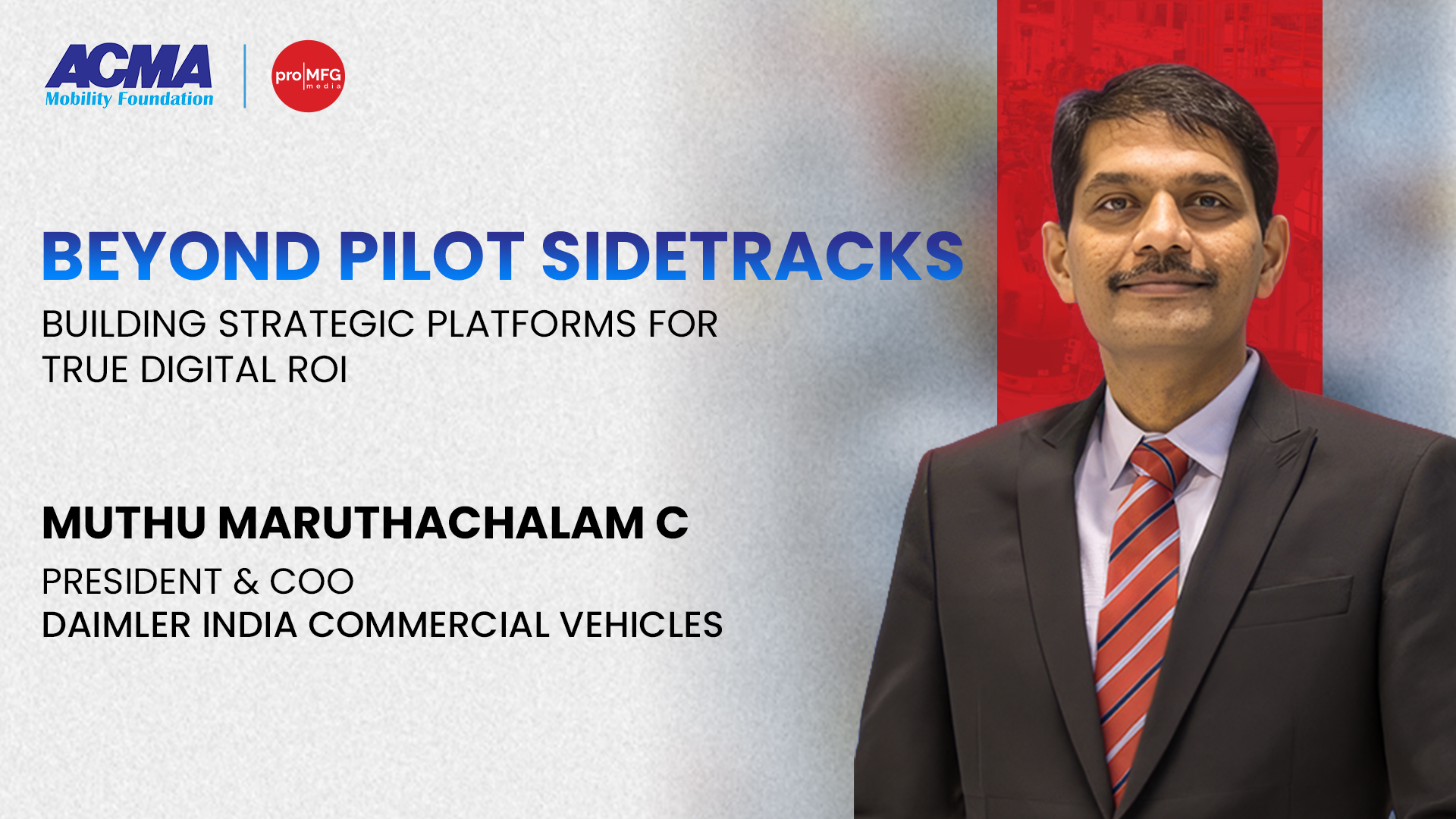
Beyond Pilot Sidetracks: Building Strategic Platforms for True Digital ROI
#DigitalTransformation #ProMFGMedia #SmartManufacturing #FutureOfMobility #AutomotiveInnovation #SustainableManufacturing #Industry40 #AutomotiveLeadership #EVIndia #ACMAThinkTurf2026"Technology is only 20% - 30% of the value equation. The remaining 70% comes down to your people, your processes, and the willingness to let small, everyday improvements compound over time." - Muthu Maruthachalam C, President & COO, Daimler India Commercial Vehicles
September 2026 : Picture a factory floor humming with automated guided vehicles, connected sensors, and predictive algorithms. It looks impressive on paper, but ask the leadership team a simple question: Is this digital network actually solving core operational bottlenecks, or is it just a collection of fragile pilot projects that will vanish when the project manager changes roles?
At the 4th Edition of the ACMA Automotive Smart Manufacturing Think Turf 2026 powered by Pro MFG Media, industry leaders gathered under the theme Transforming Mobility: Innovation, Integration, and Impact.
In a candid panel discussion titled "Gears of Automotive Growth: Resilient, Automated & Intelligent Manufacturing," Muthu Maruthachalam C, President & COO at Daimler India Commercial Vehicles (DICV), shared a grounded, executive perspective on stripping away digital vanity, building global supply chain consistency, and empowering shop-floor workers to innovate.
1. Defining "Intelligent Manufacturing": Transparency First
Over the past few years, the manufacturing sector saw a frenzy of isolated digital projects. Yet, as Maruthachalam pointed out, many of these "cool" use cases lack long-term viability because they aren't tied to fundamental business outcomes.
To him, intelligent manufacturing isn't about collecting data for its own sake - it is about using technology as a lever to create absolute transparency.
When systems bring operational leakages into clear focus, managers can target true waste. Crucially, digital platforms must be treated as a long-term strategic investment rather than a quick two-year traditional ROI fix. Without an enterprise-wide platform architecture, isolated pilot projects inevitably turn into operational dead ends.
2. Localization Beyond Batch One: The Consistency Imperative
With DICV achieving roughly 92% localization for Daimler trucks in India, the conversation around domestic manufacturing has fundamentally evolved. India can easily manufacture to global specifications - the true test lies in batch-to-batch consistency.
"The global perception that Indian parts are cheap but inconsistent has largely shifted, but a small iota of doubt remains among international buyers," Maruthachalam noted.
Overcoming that perception requires moving past end-of-line inspections. DICV works hand-in-in-hand with domestic vendors across the entire value chain - helping Tier-1 and Tier-2 suppliers stabilize their internal processes so they can deliver flawless quality consistently over time.
3. The Human Equation: Creating Capacity for Innovation
How do you get shop-floor workers to care about innovation when their days are packed with routine firefighting?
Maruthachalam introduced three critical pillars:
- • Culture & Mindset: Leadership must create psychological safety by encouraging calculated risk-taking and accepting that some experiments will fail.
- • Redefining Innovation: Demystify the concept. Innovation isn't just a grand invention by R&D; it’s simply "doing something better today than you did yesterday."
- • Creating Capacity: You can't ask people to innovate if their schedules are 100% consumed by daily routines.
To solve this, DICV implemented a bold policy inspired by industry best practices: a weekly one-hour production line pause.
"We stop production for one hour every week across the board," Maruthachalam shared. "That time is dedicated entirely to our frontline team members to think about process improvements. The bottom-up ideas coming out of those sessions have been phenomenal."
As Indian auto manufacturing solidifies its position in the global supply chain, success won't be measured by the number of digital tools deployed. It will be driven by organizations that build robust cross-functional platforms, demand ruthless consistency from local suppliers, and give their workforce the time and freedom to drive continuous improvement.

NEWSLETTER
TRENDING ON PRO MFG

MORE FROM THE SECTION