Driving the Future: How MathWorks is Accelerating Automotive AI
#AutomotiveAI #MATLAB #Simulink #ReducedOrderModeling #EmbeddedAI #EdgeAI #GenerativeAI #ModelBasedDesign #ProMFGMedia #MathWorks
June 2026 : The automotive industry is evolving at a breakneck pace, forcing engineering teams to completely rethink how they transition from high-fidelity simulations to real-time deployment. To address these shifting dynamics, MathWorks presented a webinar titled "Accelerating Automotive AI with MATLAB: Faster Simulations with ROM and Efficient Embedded Deployment," powered by Pro MFG Media.
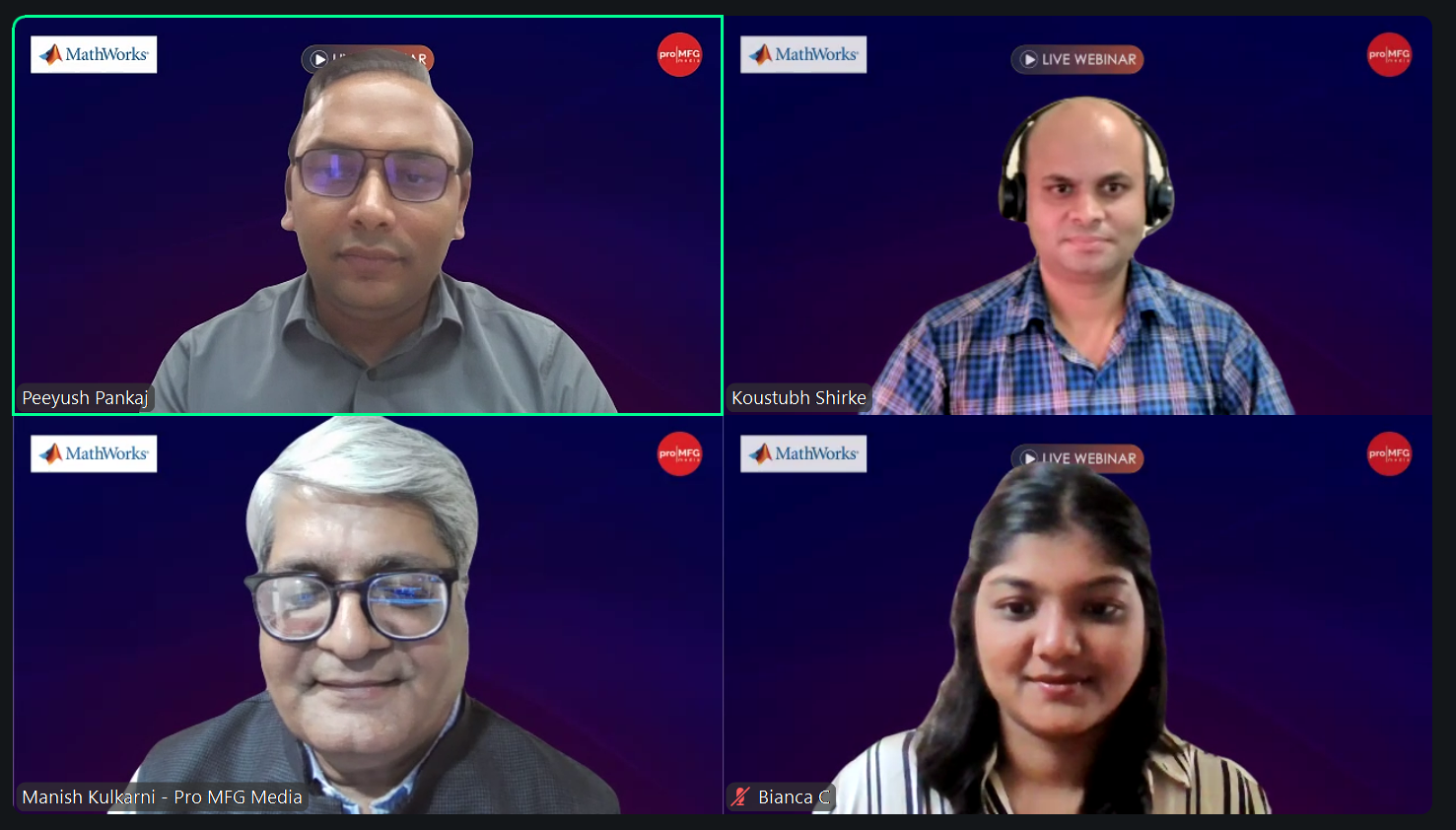
The session, facilitated by Manish Kulkarni from Pro MFG Media, featured deep-dive technical insights from MathWorks experts Koustubh Shirke (Principal Application Engineer) and Peeyush Pankaj (Senior Team Lead). Together, they outlined how modern engineering teams can maintain safety and performance standards while drastically reducing development cycles.
A core focus of the discussion was bridging the gap between heavy, computationally demanding simulations and the nimble environments required for real-time operation. This is where Reduced Order Modeling (ROM) changes the game.
Peeyush Pankaj explained that ROM essentially takes a high-fidelity model and transforms it into a low-fidelity AI surrogate that yields nearly identical results in a fraction of the time. By utilizing advanced data sampling methods in MATLAB like Latin Hypercube sampling, engineers can precisely control their simulation datasets without losing structural integrity.
The webinar highlighted a powerful real-world case study with German automotive firm TWT GMBH, where engineers used these deep learning-based surrogates to optimize vehicle suspension systems, compressing days of traditional simulation work into mere minutes. Additional examples showed a 2x to 3x simulation speedup for standard passenger vehicle models, and a massive 6x acceleration when integrated into Electric Vehicle (EV) battery thermal management systems.
Building an accurate AI model on a desktop is one thing; flashing it onto a memory-constrained microcontroller is another entirely. Koustubh Shirke tackled this challenge by introducing critical AI compression workflows available in MATLAB:
● Pruning & Projection: Cutting structural layers and reducing dimensions to shrink the model's footprint.
● Quantization: Converting double-precision data into single-precision data to significantly optimize hardware memory usage.
Shirke noted that while compression might cause a nominal 1% to 4% drop in accuracy, the trade-off yields an incredibly fast, memory-efficient model perfectly tailored for Edge AI and on-board diagnostics.
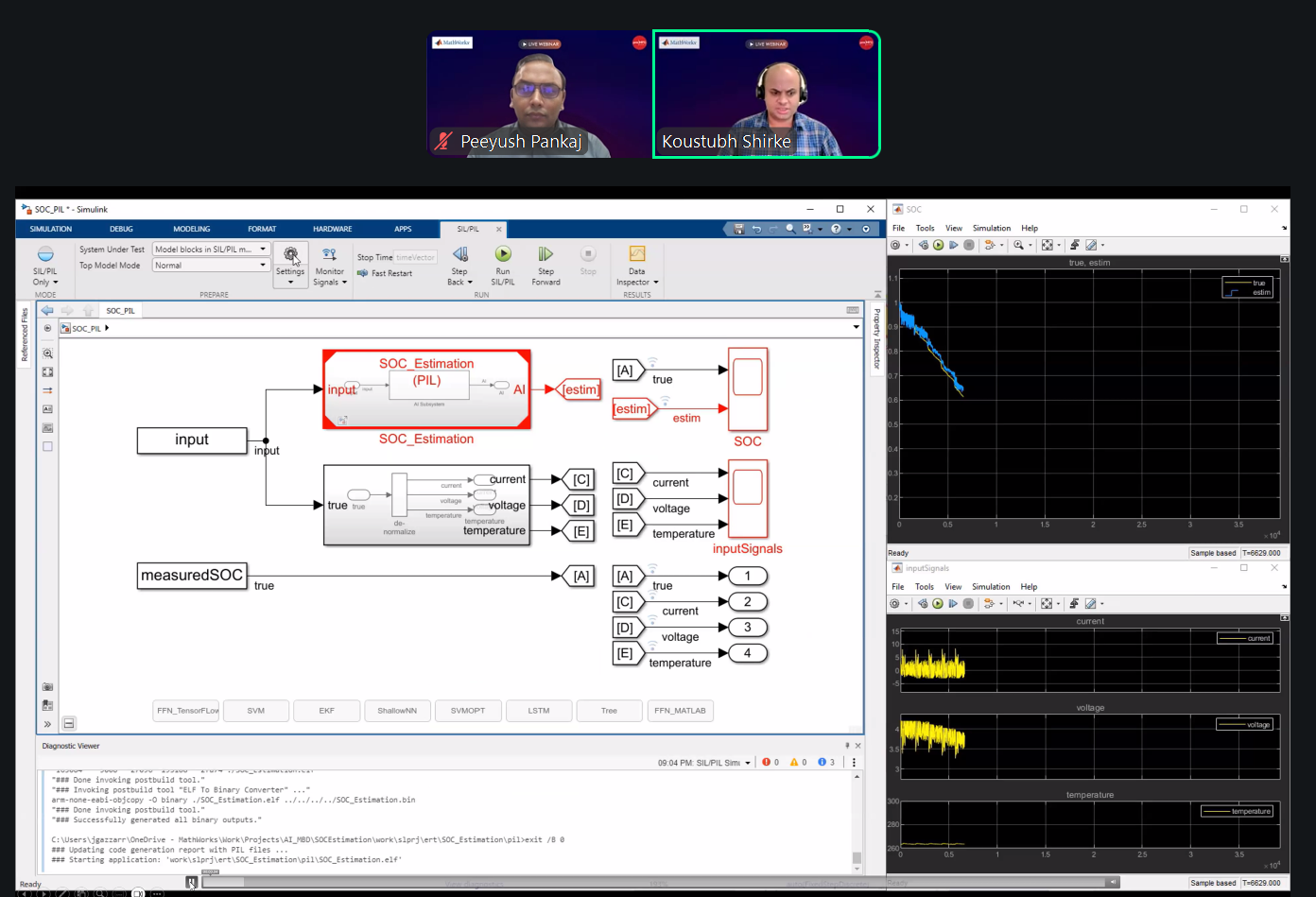
Furthermore, the presenters demonstrated MATLAB’s automatic code generation framework, which seamlessly translates deep learning models into library-free C/C++ or optimized target-specific code for hardware like NXP, TI, and NVIDIA boards. Through Processor-in-the-Loop (PIL) simulation, engineering teams can verify exact model performance, static/dynamic memory limits, and execution speeds directly on the hardware before moving to final production.
The webinar also peeled back the curtain on how Generative AI is reshaping engineering productivity. MathWorks showcased the MATLAB Copilot, an in-environment chatbot trained explicitly on MathWorks documentation to help engineers automatically generate, optimize, and troubleshoot code lines.
Going a step further, the discussion explored Agentic AI via the MATLAB Agent Toolkit. Utilizing the Model Context Protocol (MCP), engineers can pair Large Language Models (LLMs) with MATLAB and Simulink to execute autonomous workflows - like prompting an AI agent to extract data, run an exploratory analysis, and train a Machine Learning model from scratch without human intervention. This focused, specialized execution significantly reduces AI "hallucinations" while optimizing token usage.
From predictive maintenance to formal neural network verification in safety-critical systems like braking and steering, the session made it clear that integrated AI toolkits are defining the next era of automotive engineering.

NEWSLETTER
TRENDING ON PRO MFG


MORE FROM THE SECTION