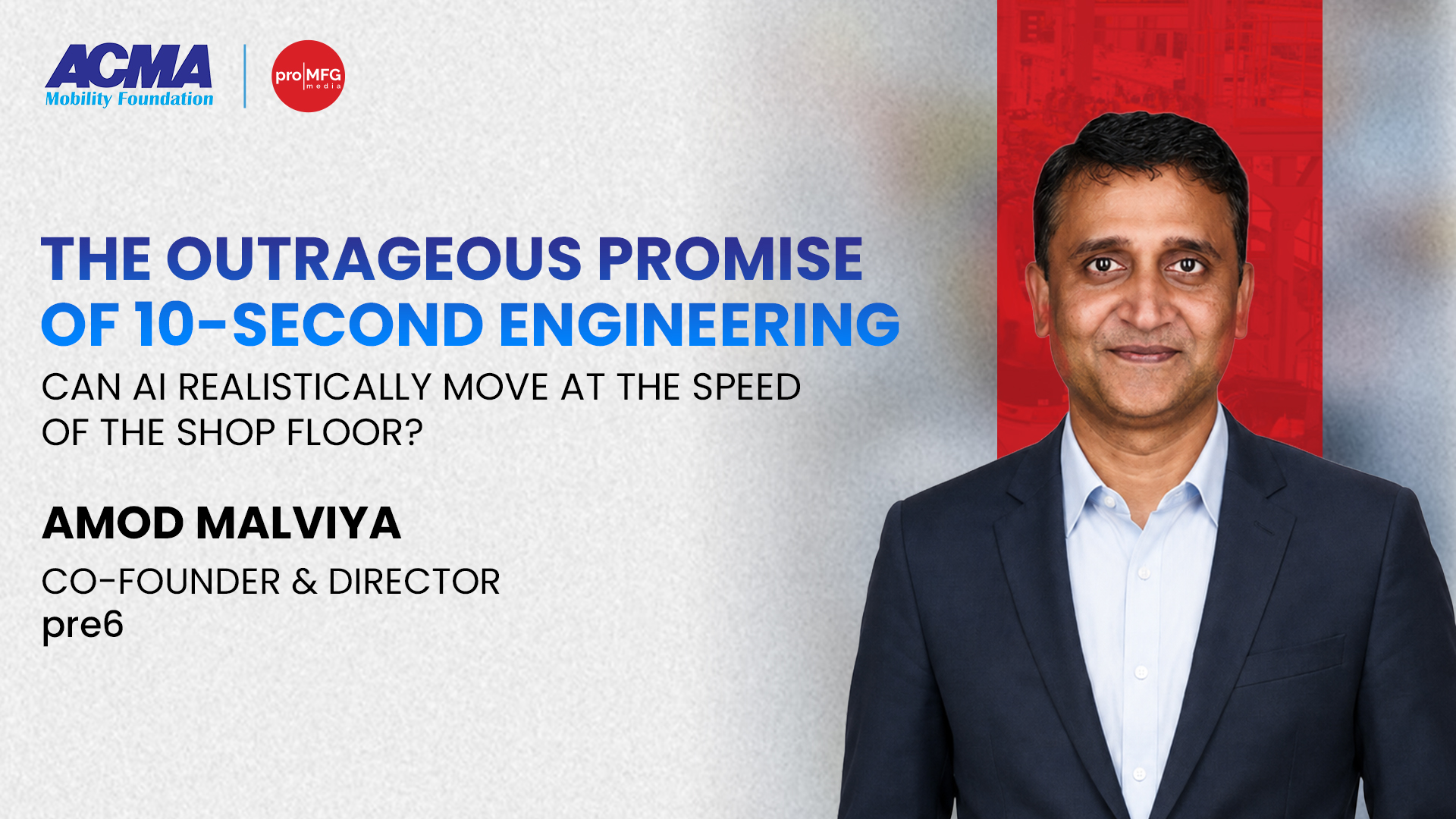
The Outrageous Promise of 10-Second Engineering: Can AI Realistically Move at the Speed of the Shop Floor?
#MobilityReimagined #SmartManufacturing #AIinManufacturing #Pre6AI #QualityIntelligence #AutomotiveTech #ShopFloorAI #ACMAThinkTurf #DFM #DigitalTransformation"If an AI claim sounds completely outrageous to a seasoned plant manager, it usually means one of two things: it’s vaporware, or it’s about to change the manufacturing landscape forever. We welcome the skepticism - put us to the test." - Amod Malviya, Co-founder and Director, Pre6
September 2026 : When you stand in front of a room packed with automotive plant managers, procurement heads, and quality engineers, you learn very quickly that they do not care for fluff. They manage operations where every single second is tied to a balance sheet, and where standard engineering workflows are slow, tedious, and stubborn by design.
So, when Amod Malviya, Co-founder and Director of Pre6, took the stage at the 4th Edition of the ACMA Automotive Smart Manufacturing Think Turf 2026, powered by Pro MFG Media, he decided to skip the standard corporate pleasantries. Instead, he dropped a series of metrics that deliberately disrupted the room's collective comfort zone.
Speaking under the summit’s central banner - Transforming Mobility: Innovation, Integration, and Impact - Malviya laid down the traditional manufacturing timeline versus the new reality Pre6 is deploying across shop floors in India and Europe:
- • Component Ballooning & Inspection Plans: Traditional time: 5 hours to two days. Pre6 AI time: 10 seconds.
- • DFM-Aware RFQ Costing: Traditional time: 12 to 48 hours. Pre6 AI time: 10 minutes.
- • PPAP, PFMEA & Control Plans: Traditional time: A grueling few days. Pre6 AI time: 20 minutes.
The secret behind these compressed timelines isn't a generic web wrapper around mainstream public AI models. For an AI to accurately reason about a complex geometric casting or an industrial step file, it has to be built specifically for the physical laws of manufacturing.
"We have purpose-built AI models that inherently understand manufacturing physics," Malviya explained. "They interpret 3D CAD models and 2D engineering drawings natively. Because these are our proprietary models running on our own dedicated GPU servers, we can guarantee data security, intellectual property safety, and real-time execution speeds that off-the-shelf software simply cannot match."
During a live demonstration, Malviya showcased how a user can upload a raw step file, select a material like TPU or ABS, and watch the AI run a comprehensive, real-time Design for Manufacturability (DFM) analysis. The system automatically detects injection gates, predicts complex plastic flow patterns, catches potential weld lines or air traps in seconds rather than hours, and instantly outputs cross-geography cost comparisons between manufacturing hubs like Germany and China.
This gives purchasing teams inside major OEMs the immediate leverage to spot check quotes, and empowers supplier RFQ teams to respond to massive clients without constantly pulling a senior design engineer off the production line.
Perhaps the most exhausting administrative hurdle on any automotive shop floor is the Production Part Approval Process (PPAP). It typically involves rooms of engineers manually cross-referencing hundreds of geometric dimensions, calculating Risk Priority Numbers (RPN), and filling out endless rows in heavy, slow Excel sheets to remain AIAG compliant.
Pre6’s approach treats the blueprint as a visual canvas rather than an administrative chore. By uploading a Process Flow Diagram (PFD) and connecting it to a component drawing, the AI instantly balloons over a hundred distinct engineering parameters and tolerances simultaneously.
Instead of typing out rows, engineers simply point and click to map specific dimensions to machining steps like drilling or casting. The AI automatically compiles the background PFMEA data, references the factory's unique institutional history, and outputs a personalized, audit-ready control plan within three and a half minutes.
The overarching takeaway from the Pre6 presentation at the ACMA Think Turf is a sharp reminder of what true digital integration looks like. AI’s role in modern automotive manufacturing isn't just about replacing manual data entry; it’s about liberating the factory's brightest human engineers from bureaucratic paperwork, allowing them to focus entirely on what they do best: actual innovation, integration, and impact.

NEWSLETTER
TRENDING ON PRO MFG

MORE FROM THE SECTION