The Smart Maintenance Shift: Data Driven Decision Making
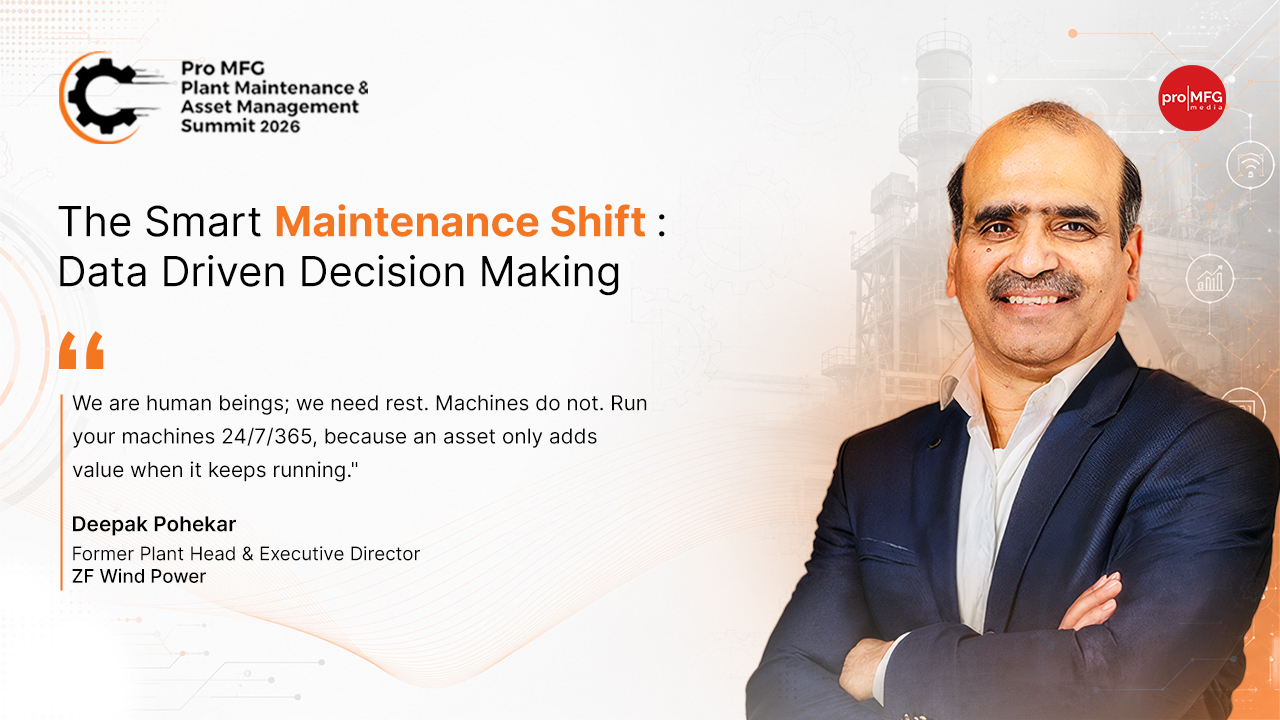
#ProMFG2026 #PMAMSummit #SmartMaintenance #PredictiveMaintenance #PlantOperations #ReliabilityEngineering #AssetManagement #IoTInManufacturing #ZFWindPower"We are human beings; we need rest. Machines do not. Run your machines 24/7/365, because an asset only adds value when it keeps running." - Deepak Pohekar, Former Plant Head & Executive Director, ZF Wind Power
June 2026 : The maintenance team is traditionally the most elusive crew in any manufacturing plant. They are the firefighters, constantly sprinting toward the latest loud noise or sudden breakdown. But recently in Coimbatore, a roomful of these busy professionals managed to step away from the grease and the alarms for a day to rewrite the rulebook on plant reliability.
The gathering was the 7th Edition of the Pro MFG Plant Maintenance & Asset Management (PMAM) Summit 2026. Hosted by Pro MFG Media alongside Presenting Partner Mobil and Gold Partner ImageGraphix, the summit zeroed in on a critical theme: Smart Maintenance - Leveraging Digital Tools for Reliable Plant Operations.
Among the standout speakers was Deepak Pohekar, Former Plant Head & Executive Director at ZF Wind Power. With nearly four decades of hands-on experience, Pohekar brought a refreshingly candid, human perspective to an industry often bogged down by overcomplicated buzzwords.
Pohekar opened by highlighting the classic paradox of plant management: teams are often too trapped in a cycle of constant breakdowns to get the training necessary to stop them. "It's a chicken-and-egg story," Pohekar explained. "If the team is trained, they maintain the machine well and save time. But if chronic problems aren't solved by engineering them out of existence, everyone stays busy firefighting."
To illustrate how data can break this loop, he shared an example of a seized spindle at his factory. The initial diagnosis was simple: the temperature spiked because lubrication had failed. But Pohekar looked deeper. The machine manufacturer had set the high-temperature alarm at a catastrophic 120°C. Instead of waiting for the next emergency, his team began tracking the baseline data. If a machine normally runs at 40°C, they programmed an alert for a minor 10-degree deviation rather than a 100-degree spike. This shift from time-based maintenance to condition-based data monitoring yielded massive dividends. For Indian manufacturing, smart data utilization is the ultimate cost equalizer.
When asked which digital tools yield the highest return on investment, Pohekar compared technology to a pharmacy: you don't buy every medicine on the shelf; you buy what cures your specific ailment. Digitalization doesn't require an immediate, multi-million-dollar investment. Pohekar recalled using a simple handheld thermometer back in 1998 to scan control panels. Out of 3,000 manual observations, his team caught 30 thermal abnormalities - effectively preventing 30 massive, unplanned breakdowns with minimal budget.
For modern plants looking to scale up, he suggested a highly relatable approach: treat your machines like cricket players. "When you watch an IPL match, every metric is right there on the screen as the player walks out," Pohekar said. "You know their run rate, their failures, and their averages. Do the exact same thing with your data. Treat your machine as your star player, track its performance metrics, and watch how it delivers." This data-focused approach feeds into tracking Total Equipment Productive Productivity (TEPP) - calculating overall equipment effectiveness across a strict 24/7, 365-day calendar. This rigorous data tracking ensures that major capital expenditure and machine replacement decisions are backed by hard numbers rather than guesswork.
In an era dominated by talk of Industry 4.0, IoT, and artificial intelligence, Pohekar left the audience with a grounding truth: technology is an enhancer, not a magic wand. Digitalizing a broken process just gives you a digitalized broken process.
He recalled an ongoing headache where expensive electronic cards were repeatedly failing. The root cause wasn't software - it was India’s ambient dust, moisture, and 40°C+ summer heat hitting equipment designed for mild European climates. The fix wasn't an IoT sensor; it was a 25-lakh investment to improve the physical cooling systems of the control panels. The card failures stopped instantly.
"Root cause is everything," Pohekar concluded. "It might take you years to truly find it, but once you solve the root cause, the problem never occurs again. That is the ultimate test of smart engineering."

NEWSLETTER
TRENDING ON PRO MFG



MORE FROM THE SECTION