Beyond the Shop Floor: Driving Business Transformation Through Connected Synchronization
#SmartBusiness #ManufacturingTransformation #TheoryOfConstraints #Traceability #Industry40 #BatchProcessing #SupplyChainSynchronization #Operationalexcellence #DigitalTwin #QualityAssurance
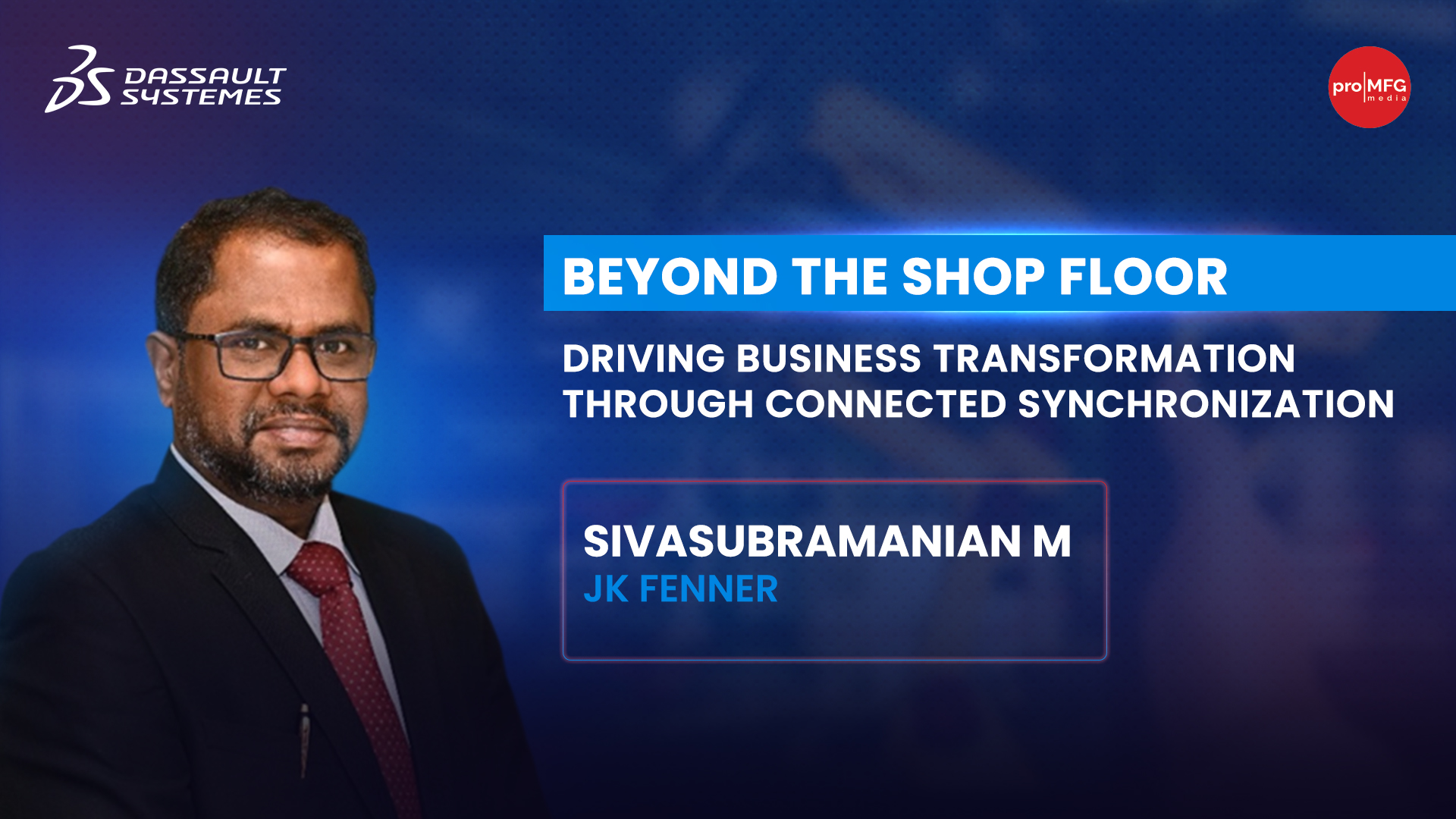
January 2026 : In a high-volume batch processing environment, the distance between a raw material shipment and a satisfied customer can be a maze of thousands of SKUs and multiple production sites. At a recent roundtable hosted by Dassault Systèmes, Sivasubramanian M from JK Fenner redefined the scope of modern industrial tech. For him, the goal isn't just "smart manufacturing" - it is a wholesale "smart business transformation" that links every heartbeat of the factory to the actual needs of the market.
Operating in a batch processing industry presents unique challenges. Unlike continuous flow, every step in a batch sequence must be a gatekeeper for the next. Sivasubramanian emphasizes that for a system to be truly integrated, the communication must be seamless and automated. "Right from raw material till the finished goods, everything is one machine. Every step has to be talking to each other, so that at least I communicate whether the quality cleared things only are going ahead. It's all integrated."
By treating the entire production chain as a single, unified machine, manufacturers can ensure that errors are caught at the source rather than at the final inspection. This synchronization prevents the waste of processing sub-par materials and ensures that only "cleared" batches consume valuable machine time.
Managing a massive portfolio of SKUs is a cognitive burden that no human operator can handle alone. Sivasubramanian highlights the use of the Theory of Constraints (TOC) as a guiding principle to determine what to produce and when. In an environment with "a lack of SKUs" or overwhelming variety, technology acts as the navigator.
The focus is on synchronizing the entire process - from raw material creation to equipment efficiency - without compromising on quality. The system tells the plant exactly what the customer wants, effectively pulling production through the factory rather than pushing it blindly into a warehouse.
One of the most critical competitive advantages of a connected system is the ability to look backward from a finished product. In the event of a customer complaint in the field, a truly smart business doesn't guess; it knows.
"By seeing and identifying it itself, we should be in a position to track whether we have multiple plants. So which plant has been produced, which batch... right from need till servicing the customer." This level of traceability - knowing which batch was produced at which plant under what conditions - creates a closed-loop system of accountability. It transforms manufacturing from a series of isolated events into a transparent journey.
Ultimately, Sivasubramanian’s vision is one where technology dissolves the walls between procurement, production, and service. When data flows as freely as the materials on the conveyor belt, the result isn't just a smarter factory - it’s a more agile, responsive, and resilient business.

NEWSLETTER
TRENDING ON PRO MFG



MORE FROM THE SECTION