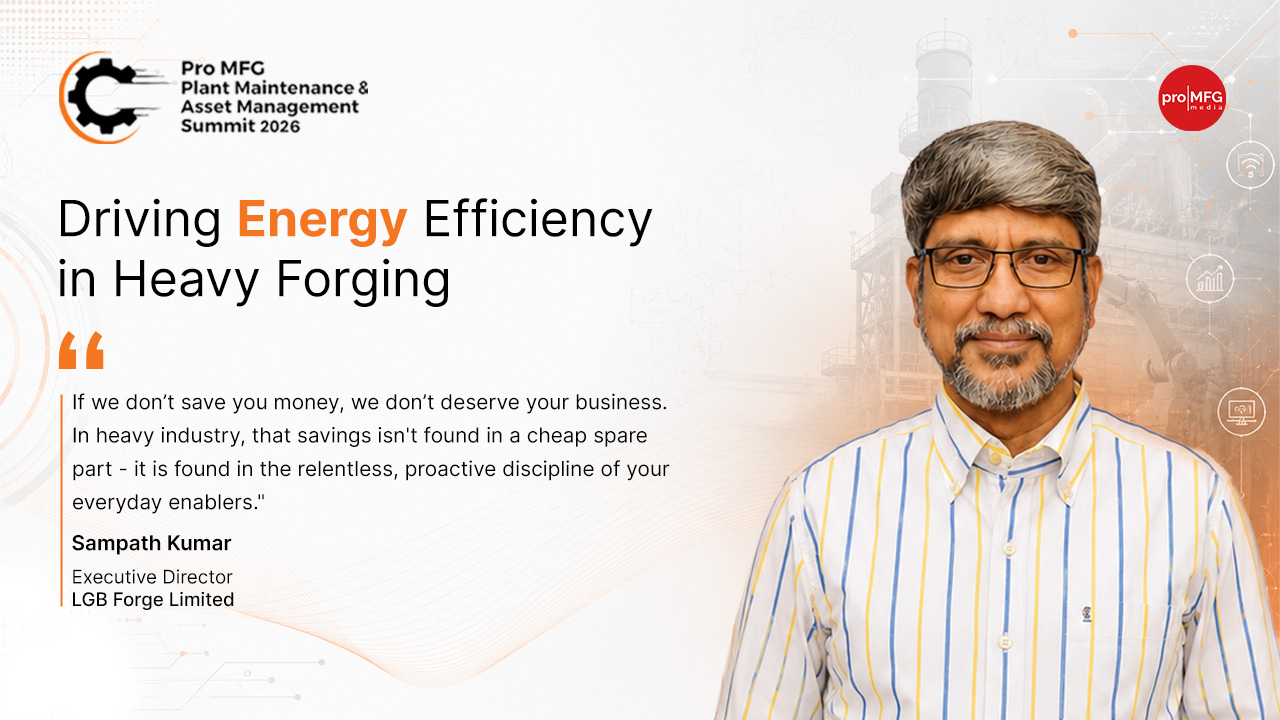
Driving Energy Efficiency in Heavy Forging
#ProMFG2026 #PMAMSummit #SmartMaintenance #ForgingIndustry #TotalProductiveMaintenance #IndustrialLubrication #MobilLubricants #AssetUptime #ProactiveMaintenance"If we don’t save you money, we don’t deserve your business. In heavy industry, that savings isn't found in a cheap spare part - it is found in the relentless, proactive discipline of your everyday enablers." - Sampath Kumar, Executive Director, LGB Forge Limited
July 2026 : When industrial engineers talk about digital transformation, they often picture clean, air-conditioned assembly floors where robotic arms glide effortlessly through space. But there is another side to manufacturing - the heavy, intense world of hot forging. Here, components are hammered into shape at a punishing 1200°C. In this high-heat, high-friction environment, you cannot simply look at a glowing piece of steel with the naked eye to see if a process variation has occurred. Your assets face brutal conditions every single minute, and a sudden breakdown can paralyze a 30-crore production line.
This focus on operational survival was the highlight of the discussion at the 7th Edition of the Pro MFG Plant Maintenance & Asset Management (PMAM) Summit 2026 in Coimbatore. Hosted by Pro MFG Media alongside Presenting Partner - Mobil and Gold Partner - ImageGraphix, the panel focused on Achieving Maximum - Driving Productivity & Cost Efficiency Across Assets.
Bringing a gritty, practical perspective to the panel was Sampath Kumar, Executive Director of LGB Forge Limited. Kumar explained how heavy manufacturers can maintain strict reliability despite shifting workforces and harsh operational environments.
For Kumar, the foundation of modern asset productivity isn't a complex piece of software; it is Total Productive Maintenance (TPM) - a structured framework that has supported global industry for over 70 years. "Before racing toward advanced, over-engineered tech, establish a stable TPM baseline," Kumar urged. This doesn't mean blindly copying complex blueprints from a clean electronics assembly line. Instead, heavy industries must simplify and adapt these tools to fit their unique floor conditions. Combined with a robust daily monitoring system, this baseline gives teams the immediate feedback they need to spot operational deviations and take corrective action together.
This structured approach becomes even more critical when managing modern labor challenges. Heavy manufacturing lines increasingly rely on migrant workforces from across the country, leading to high attrition rates. When an operator may only stay with a business for a short time, the plant cannot rely purely on unwritten tribal knowledge to safeguard a 30-crore machine. To protect these capital investments, factories must combine low-cost automation with clear, standardized floor systems. This integration ensures that even as the faces on the floor change, process discipline remains entirely consistent.
When the panel turned to energy efficiency, Kumar highlighted the critical role played by industrial lubrication. He pointed out that while advanced software gets the headlines, high-tier lubricants and greases are the true quiet enablers of continuous 24-hour asset operation. Quoting Mobil's direct business philosophy - "If we don’t save you money, we don’t deserve your business" - Kumar noted that high-grade synthetic oils reduce internal machine friction in ways the naked eye can't see, directly lowering total power draw. In extreme applications like wind turbines or isolated industrial gearboxes, these advanced fluids provide "fill-and-forget" reliability that protects components for up to seven years without a change.
Kumar closed with a strong warning against short-sighted maintenance cutting. When a complex asset breaks down, hurried teams often try to save money by replacing a single worn gear or seal rather than servicing the entire sub-assembly. While this quick patch limits immediate maintenance expenses, it almost always guarantees another breakdown a few thousand hours later. True cost optimization requires moving beyond reactive patches to proactive, assembly-level maintenance. By combining high-grade spares with premium lubricants and a stable TPM culture, manufacturers can keep their critical assets running smoothly for the long haul.

NEWSLETTER
TRENDING ON PRO MFG


MORE FROM THE SECTION