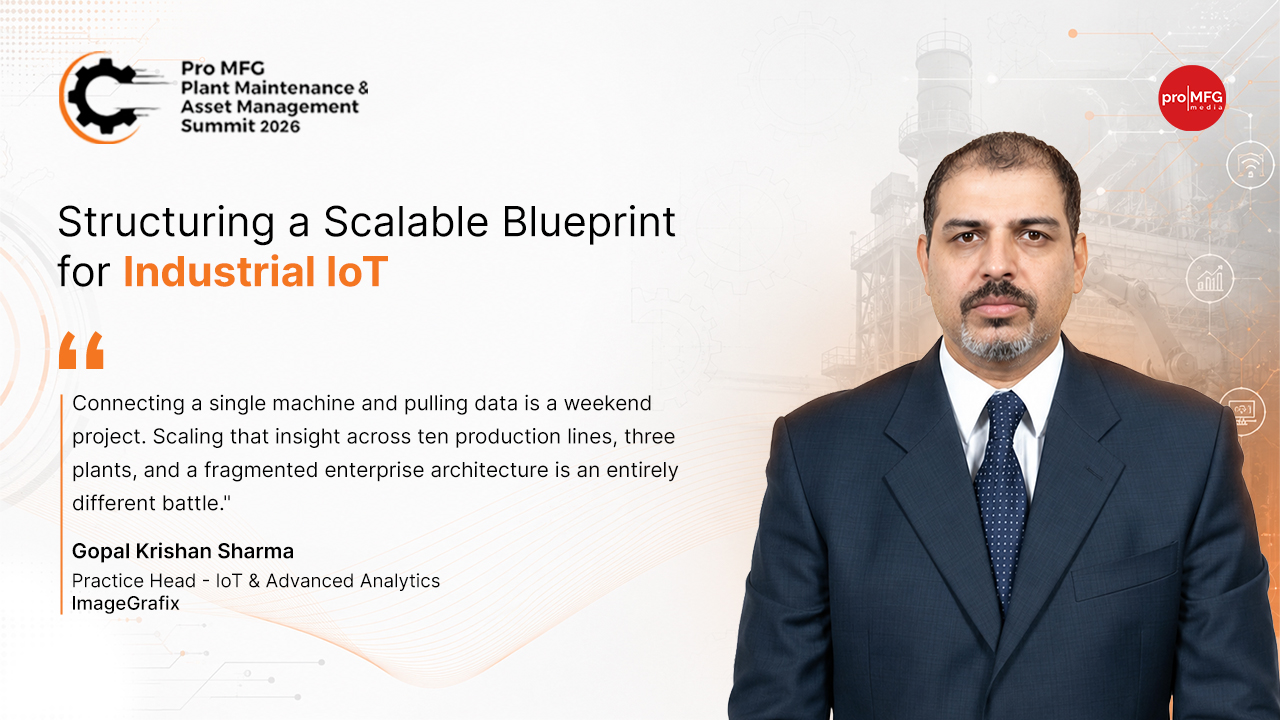
Structuring a Scalable Blueprint for Industrial IoT
#ProMFG2026 #PMAMSummit #IndustrialIoT #AdvancedAnalytics #DigitalTransformation #SmartManufacturing #ImageGrafix #DataArchitecture #Industry40"Connecting a single machine and pulling data is a weekend project. Scaling that insight across ten production lines, three plants, and a fragmented enterprise architecture is an entirely different battle." - Gopal Krishan Sharma, Practice Head - IoT & Advanced Analytics - ImageGrafix
June 2026 : This critical roadblock to digital transformation took center stage at the 7th Edition of the Pro MFG Plant Maintenance & Asset Management (PMAM) Summit 2026 in Coimbatore. Hosted by Pro MFG Media alongside Presenting Partner - Mobil and Gold Partner - ImageGrafix, the panel focused on Emerging Technologies - Transforming the Manufacturing Facility Gears Toward Tomorrow’s Capabilities.
Stepping up to map the journey from isolated data points to enterprise-scale intelligence was Gopal Krishan Sharma, Practice Head of IoT & Advanced Analytics at ImageGrafix. Sharma broke down how industrial leaders can build data foundations that actually scale.
When factory teams encounter an immediate operational challenge - like tracking critical component wear - they naturally look for the fastest technical fix available. They write custom scripts and use whatever localized industrial protocols are closest at hand to pull the data. While this quick setup provides immediate visibility, it often leaves out the long-term roadmap. It fails to consider how that data will integrate with broader Manufacturing Execution Systems (MES) or Enterprise Resource Planning (ERP) platforms later on. "We bring the technical product expertise, but more importantly, we help companies step back and design the roadmap," Sharma explained. "It is perfectly fine to start small with a minor initial project, but the underlying data architecture must be robust enough from day one to handle an enterprise-wide rollout."
To move past one-off factory floor dashboards, industrial IT and manufacturing operations departments must align on a common technical framework. Sharma highlighted three core areas where specialized external guidance helps plants avoid expensive architectural dead ends:
- 1. Standardizing Industrial Protocols: A typical factory floor functions like a digital Tower of Babel, featuring legacy machines, modern automated systems, and varied PLCs all communicating in different languages. True scale requires standardizing these streams through unified industrial protocols (such as OPC UA or MQTT) to ensure seamless data translation.
- 2. Cross-Industry Blueprinting: Many software tools are built within very specific manufacturing niches and struggle when deployed across diverse plant environments. Drawing from cross-industry deployment experience helps companies pick adaptable data architectures that survive real-world floor conditions.
- 3. Future-Proof Manufacturing IT Roadmaps: Instead of reacting to floor breakdowns as they happen, companies need to align their immediate, low-cost sensor projects with a long-term roadmap for advanced analytics and machine learning.
Ultimately, Sharma reminded the audience that technology alone isn't a silver bullet. The real value of industrial data isn't found in simply collecting it; it comes from building a reliable framework that delivers actionable insights directly to operators, plant managers, and executives alike. By building a scalable data foundation today, manufacturers can stop playing catch-up with localized problems and start engineering tomorrow's capabilities.

NEWSLETTER
TRENDING ON PRO MFG



MORE FROM THE SECTION