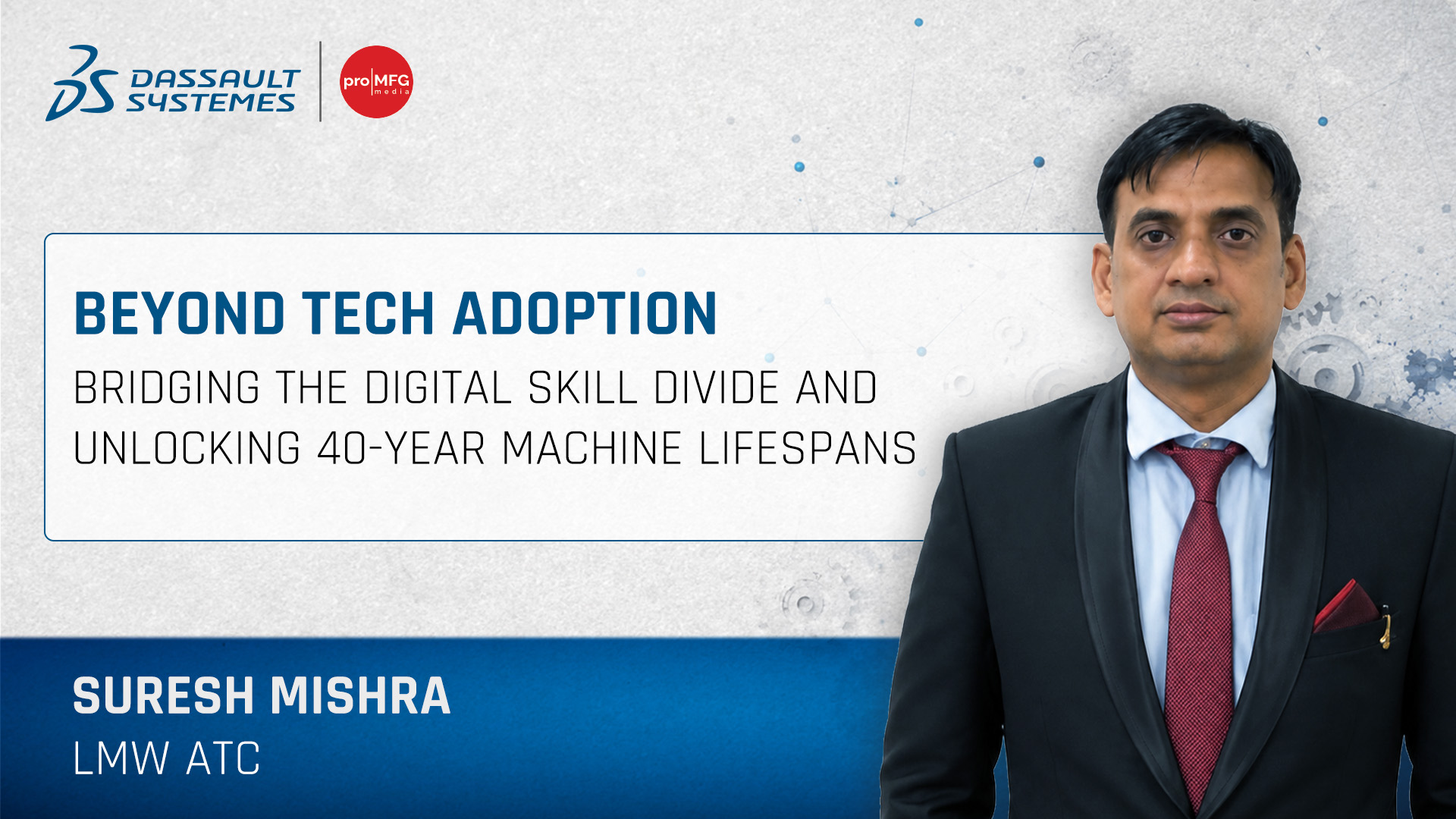
Beyond Tech Adoption: Bridging the Digital Skill Divide and Unlocking 40-Year Machine Lifespans
#SmartManufacturing #WorkforceDevelopment #ProMFGMedia #AerospaceManufacturing #Industry40 #PredictiveMaintenance #LMWATC #CapitalEfficiency #DassaultSystèmes #TataTechnologies“A smart factory cannot thrive in a struggling society. True digital transformation must elevate our workforce while keeping precision machinery running reliably for decades.” - Suresh Mishra, LMW ATC
September 2026 : While top management across manufacturing sectors is eager to roll out Smart IoT and AI solutions, the reality on the shop floor tells a more complex story. Between adoption hesitation among mid-level teams, a growing nationwide skills gap, and strict financial ROI expectations on high-value machinery, factory leaders face unique operational hurdles.
At the “Driving Profitable Growth Through Smart Manufacturing” roundtable - presented by Dassault Systèmes and Tata Technologies, powered by Pro MFG Media, and supported by ACMA India - Suresh Mishra from LMW ATC delivered a candid overview of these floor-level challenges. He highlighted how companies can bridge the gap between advanced technology and human capability, particularly when managing costly aerospace components and high-value capital equipment.
In many modern facilities, top management pushes for 90% IoT implementation. However, mid-level managers and operators often fall back on manual routines. They face packed schedules, continuous meetings, and a lack of tailored training - leaving high-tech dashboards monitored by only a handful of designated staff.
At the same time, floor operators who comfortably navigate complex smartphone apps in their personal lives struggle with industrial digital interfaces.
Closing this gap requires making factory interfaces as intuitive as consumer apps, while actively upskilling diploma holders, high school graduates, and entry-level technicians into confident digital operators.
Automation and AI naturally reduce manual labor dependency. However, Mishra emphasized that industrial growth must stay aligned with broader societal needs.
With expanding manufacturing hubs across states like Odisha, Uttar Pradesh, and West Bengal, companies face a shared challenge: an abundance of available labor, but a shortage of job-ready, skilled technicians.
"We cannot build smart, profitable plants while ignoring workforce development. Industry, academia, and government must collaborate to train available talent. Upgrading our people is essential for long-term industrial stability."
In high-precision sectors like aerospace, material costs are extremely high and raw imported stock is difficult to replace. A single machining error can result in expensive scrap and project delays.
To prevent in-process errors and satisfy strict financial payback requirements (often 3 to 4 years for machinery costing over ₹10 crore), AI applications must focus on two vital areas:
- 1. In-Process Vision Inspection: Catching design-versus-actual deviations in real time using camera-based AI before expensive aerospace alloys are damaged.
- 2. Predictive Asset Longevity: Continuous health monitoring - tracking gear wear, thermal changes, and vibration - so components are replaced before catastrophic failure occurs. This approach extends machine operational lifespans up to 30 or 40 years, protecting long-term capital investment.
Smart manufacturing reaches its full potential when human capability matches technological sophistication. By making digital tools accessible to every operator, actively upskilling the regional workforce, and leveraging AI to protect high-value capital assets, industrial leaders can achieve sustainable and profitable growth.

NEWSLETTER
TRENDING ON PRO MFG


MORE FROM THE SECTION