Beyond the Spreadsheet Trap: Using Protocol-Agnostic IoT to Connect Legacy Machines
#SmartManufacturing #OperationalExcellence #LineBalancing #Industry40 #SupplyChainAnalytics #CostOptimization #RootsIndustries #ProMFGMedia #DassaultSystèmes #TataTechnologies“Smart manufacturing isn’t just about collecting data - it’s about having a single source of truth. When your operational references move during project rollout, clear baselines keep your ROI real.” - Vijayakumar M, Roots Industries India Limited
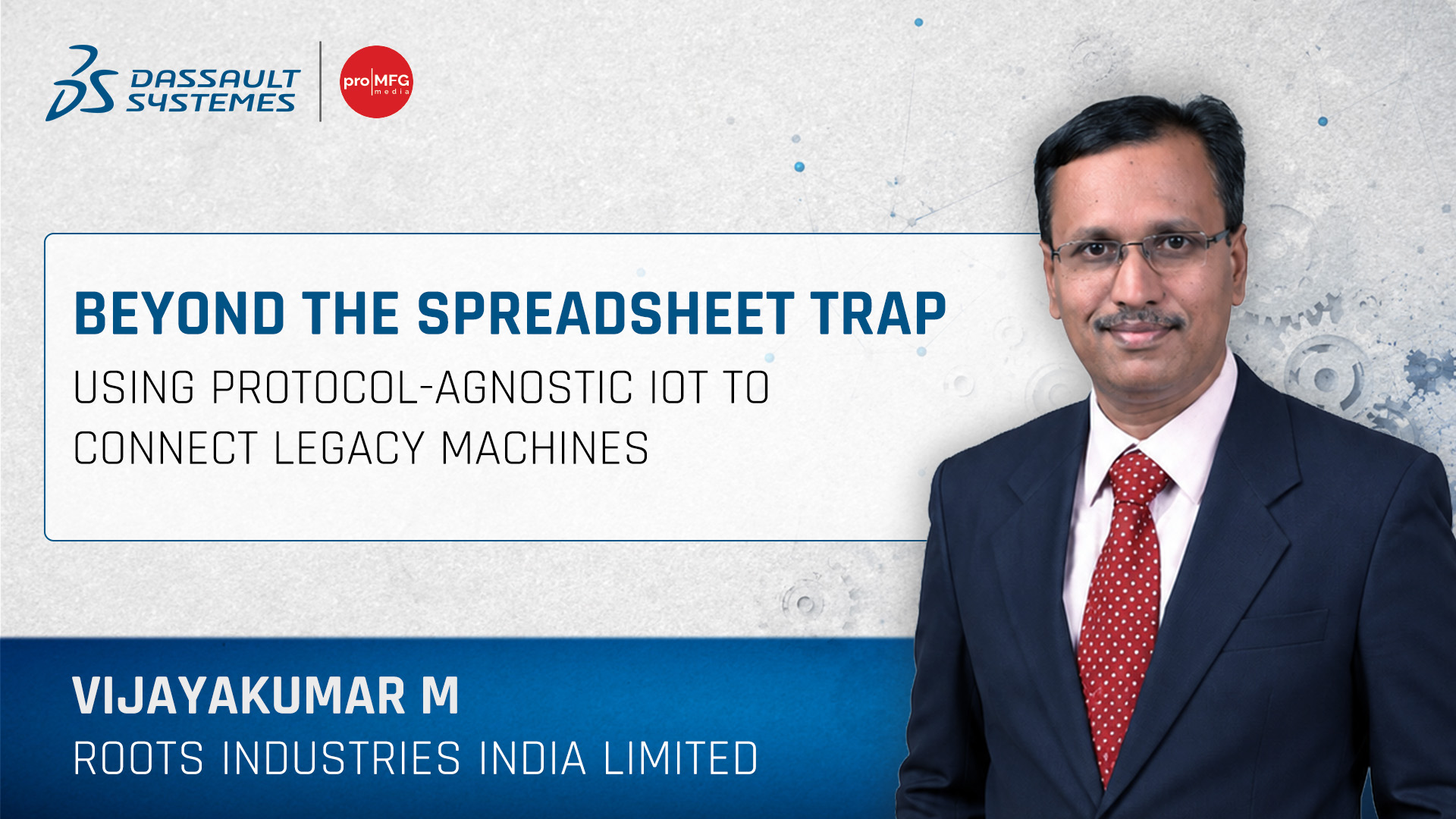
September 2026 : In manufacturing, profitability rests on three core pillars: productivity, quality, and on-time delivery. Yet, driving consistent gains across all three remains a complex balancing act - especially when material availability fluctuates and shop-floor data lives in fragmented silos.
At the “Driving Profitable Growth Through Smart Manufacturing” roundtablet - presented by Dassault Systèmes and Tata Technologies, powered by Pro MFG Media, and supported by ACMA India - Vijayakumar M from Roots Industries India Limited shared a pragmatic, data-backed blueprint for industrial efficiency. By setting aggressive headcount-optimization targets, extracting real-time telemetry from legacy machinery, and leveraging granular data analytics for material cost reduction, Roots Industries demonstrates how modern enterprises can protect margins while scaling operations.
To support 10% annual business growth without proportional labor overhead, Roots Industries sets an ambitious internal benchmark: a 15% reduction in manpower dependency through operational optimization and smart automation.
For a recent operational cycle, the plant targeted a 215-headcount efficiency gain across three distinct operational levers: By systematically addressing bottlenecks, rebalancing assembly lines, and stripping out unnecessary material handling, plants achieve higher throughput without overworking their core teams.
One of the most common friction points in factory operations is unverified data. When managers must personally check with individual operators to confirm production counts, decision-making stalls. Furthermore, because implementation projects often take two to three months to roll out, baseline reference points shift midway through execution.
"If your data isn't trusted, your reference point moves while you're implementing the solution," Vijayakumar observed.
To solve this, modern plants deploy Manufacturing Execution Systems (MES) and protocol-agnostic communication gateways. These systems connect older, legacy equipment to central networks without requiring expensive machinery replacements. Retrofitting legacy machines with smart sensors allows automated, real-time data capture - replacing manual checks with reliable, central dashboards.
When asked where Artificial Intelligence delivers the highest business value, Vijayakumar highlighted an area often overlooked by floor-focused tech initiatives: direct material costs.
Because raw materials and purchased components account for up to 50% of total product costs, small efficiencies in procurement yield massive bottom-line gains. By deploying AI tools to analyze historical purchase orders, track multi-year pricing trends, and evaluate component-level Bills of Materials (BOMs), procurement teams gain concrete evidence during vendor negotiations.
"When you evaluate data down to the lowest level of your Bill of Materials, you stop guessing and start value-engineering with your suppliers."
Smart manufacturing isn't about collecting data for its own sake. It’s about building a single source of truth that empowers teams to balance lines, eliminate non-value-added steps, and optimize supplier pricing. By combining line-level discipline with automated machine data and deep BOM analytics, manufacturers can drive sustainable, profitable growth.

NEWSLETTER
TRENDING ON PRO MFG


MORE FROM THE SECTION