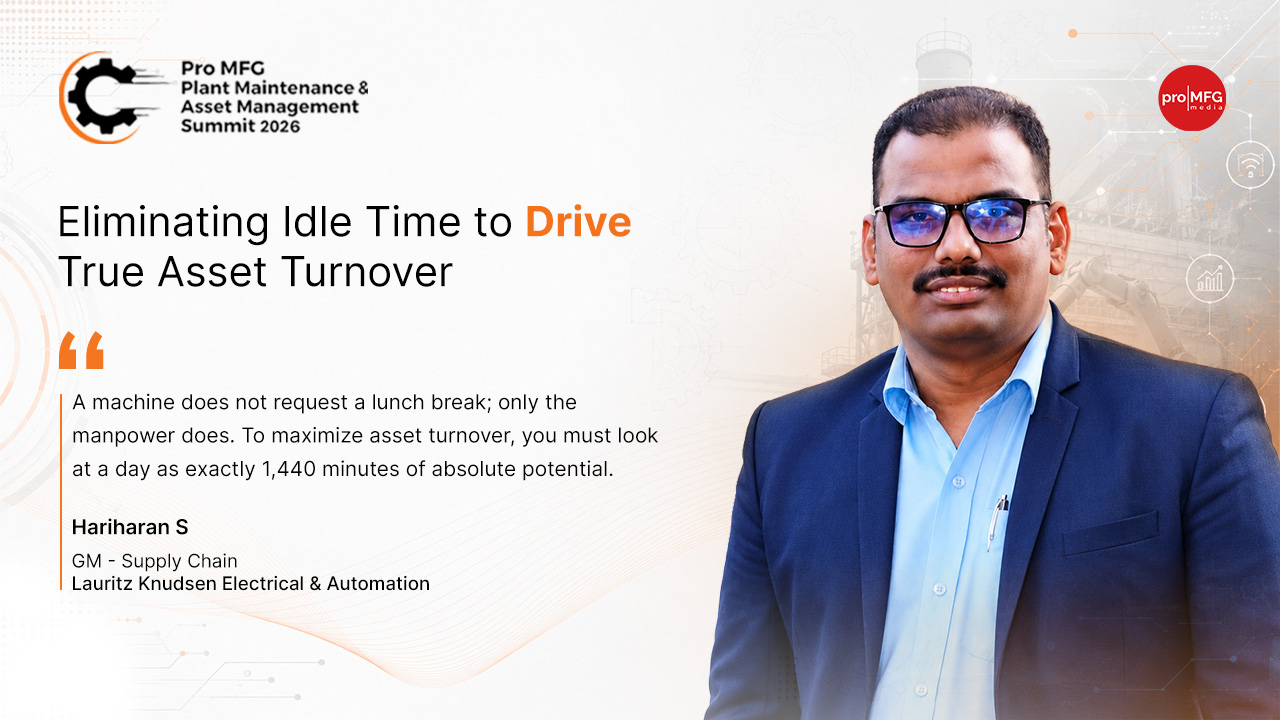
Eliminating Idle Time to Drive True Asset Turnover
#ProMFG2026 #PMAMSummit #SmartMaintenance #AssetTurnover #OEEOptimization #SupplyChainExcellence #EnergyManagement #LauritzKnudsen"A machine does not request a lunch break; only the manpower does. To maximize asset turnover, you must look at a day as exactly 1,440 minutes of absolute potential." - Hariharan S, GM - Supply Chain, Lauritz Knudsen Electrical & Automation
June 2026 : For any supply chain or operations leader, walking onto a factory floor and seeing an expensive piece of machinery sitting completely idle is the ultimate operational pain point. Often, these quiet spells are excused as routine pauses for shift changeovers, tea breaks, or scheduled lunches. However, when asset performance is judged strictly by asset turnover ratios, these small operational gaps can quickly balloon into significant productivity losses.
This practical focus on continuous efficiency was the core highlight of the panel at the <7th Edition of the Pro MFG Plant Maintenance & Asset Management (PMAM) Summit 2026 in Coimbatore. Hosted by Pro MFG Media alongside Presenting Partner Mobil and Gold Partner ImageGraphix, the session addressed a critical mandate: Achieving Maximum—Driving Productivity & Cost Efficiency Across Assets.
Bringing a practical, direct perspective to the discussion was Hariharan S, GM of Supply Chain at Lauritz Knudsen Electrical & Automation. Hariharan outlined exactly how the electrical manufacturing pioneer eliminates hidden factory floor losses.
When analyzing baseline productivity on heavy equipment - such as a turret punching press or a 200-ton stamping machine - the standard calculation of Overall Equipment Effectiveness (OEE) can often mask minor process inefficiencies. To combat this, Hariharan shared an aggressive strategy inspired by a conversation with his COO. Instead of accepting standard operational downtime during lunch hours, the facility implemented structured cross-training for its operators. When one operator steps away for a break, a cross-trained teammate steps in immediately to keep the machine running. Aside from scheduled, preventive maintenance blocks, the machine is expected to utilize all 1,440 minutes available in a 24-hour cycle.
To reliably maintain this pace, the facility moved away from traditional passive maintenance routines. "We have to move past the era where an operator arrives in the morning and simply ticks off a paper checklist without looking at the equipment," Hariharan emphasized. Under their structured performance framework, daily equipment checks are treated with religious discipline, requiring a formal counter-signature from shop floor supervisors. When an issue does emerge on a critical line, an automated Andon warning light activates immediately. This signal requires the entire support crew to assemble at the machine, establish immediate ownership, and resolve the root cause before the breakdown extends.
Hariharan also urged manufacturers to apply strict due diligence to their utility data before investing heavily in alternative or renewable energy setups. True conservation isn't about generic slogans like "turn off the computers." It requires identifying the precise energy consumed per unit produced. By leveraging an ISO 50001 Energy Management System (EMS), the maintenance department tracks and broadcasts the previous day’s energy consumption every single morning. If consumption numbers spike unexpectedly, the variance is analyzed immediately. These energy efficiency indexes are tied directly into the monthly Key Performance Indicators (KPIs) of individual team leaders, making energy accountability a factory-wide responsibility.
Ultimately, Hariharan reminded the audience that optimizing maintenance costs should never mean buying cheaper, lower-quality components. Investing in correct, high-tier spare parts from the start protects machine reliability, prevents recurring breakdowns, and ensures the plant securely captures every possible minute of production.

NEWSLETTER
TRENDING ON PRO MFG


MORE FROM THE SECTION