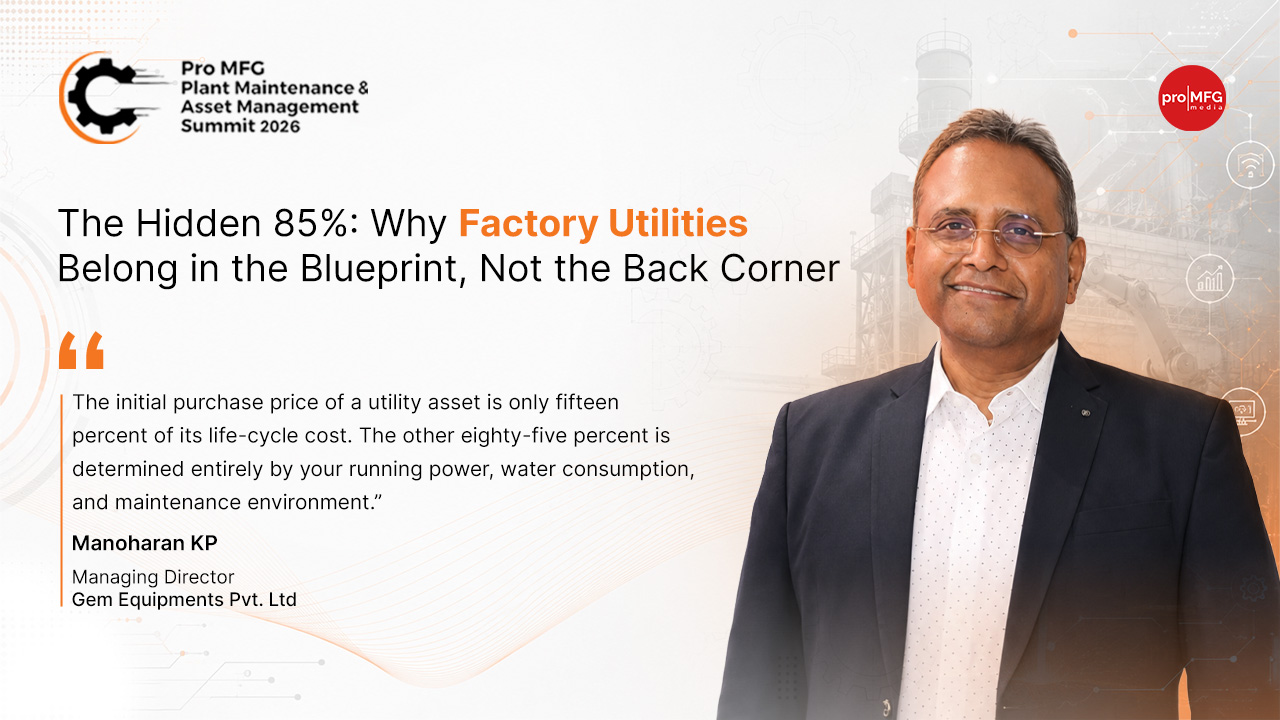
The Hidden 85%: Why Factory Utilities Belong in the Blueprint, Not the Back Corner
#ProMFG2026 #PMAMSummit #SmartMaintenance #UtilityManagement #LifeCycleCost #IndustrialChillers #EnergyEfficiency #GemEquipments"The initial purchase price of a utility asset is only fifteen percent of its life-cycle cost. The other eighty-five percent is determined entirely by your running power, water consumption, and maintenance environment." - Manoharan KP, Managing Director, Gem Equipments Pvt. Ltd
June 2026 : Walk into almost any industrial plant and ask to see the core production assets - the advanced aerospace milling machines, the automated automotive welding lines, or the heavy stamping presses - and you will be escorted to the cleanest, most prominently displayed section of the factory floor.
But ask to see the utilities - the chillers, the compressed air systems, or the cooling towers that actually keep those production assets from overheating and seizing up - and your journey will take a different turn. More often than not, you will find these critical systems tucked away in the most neglected corner of the site, crammed next to the canteens, out in the open dust, or squeezed behind the restrooms.
This critical oversight and its heavy financial impact took center stage at the 7th Edition of the Pro MFG Plant Maintenance & Asset Management (PMAM) Summit 2026 in Coimbatore. Hosted by Pro MFG Media alongside Presenting Partner - Mobil and Gold Partner - ImageGraphix, the panel focused on Achieving Maximum - Driving Productivity & Cost Efficiency Across Assets.
Bringing a unique, external service perspective to the panel was Manoharan KP, Managing Director of Gem Equipments Pvt. Ltd. and its recent venture, Gem Orion Machinery. Drawing from 41 years of servicing factory utility networks, Manoharan detailed how poor facility layouts silently destroy the life-cycle value of utility equipment.
When a company builds a new facility, it is easy to prioritize immediate capital expenses over long-term operating costs. However, Manoharan pointed out that focusing strictly on upfront machine costs creates a massive long-term financial trap. Over a standard 15-year operational lifespan, the initial purchase price of a utility asset represents a mere 10% to 15% of its total cost. The remaining 85% is swallowed up by daily energy consumption, water usage, and maintenance repairs. To combat this, Gem Equipments works with manufacturers right at the greenfield design stage. For a recent factory layout project in Sriperumbudur, the team structured the central piping design, cooling tower placements, and chiller footprints before the first stone was laid. Placing these assets in clean, accessible, and highly visible areas simplifies routine service and helps companies capture maximum utility efficiency from day one.
As industrial water scarcity intensifies, relying purely on traditional, water-heavy cooling towers is becoming a significant operational risk. To help factories operate securely without constant water dependencies, Manoharan highlighted a shift toward advanced closed-loop systems, such as dry coolers and adiabatic cooling units. These systems combine ambient air cooling with smart, low-consumption water sprays during peak heat cycles. This approach slashes a facility's process water requirements to just 10% or 15% of traditional volumes while extending the service life of internal machine components.
When the conversation turned to cutting operational costs without risking factory uptime, Manoharan pointed to inverter-driven technologies. Working alongside their 80-year-old Japanese partner, Orion, Gem has developed precision industrial chillers utilizing Permanent Magnet (PM) motor inverter drives. Unlike traditional "on-off" utility systems that undergo harsh electrical spikes and wide temperature swings every time they cycle, modern inverter-driven chillers, compressed air dryers, and cooling tower fans adjust their speed dynamically to match real-time thermal loads. This precise speed regulation cuts power consumption by 20% to 30% compared to legacy setups. More importantly, it maintains a completely stable, unfluctuating process temperature. Because consistent cooling directly improves final product quality, this thermal stability proves that saving energy isn't just about cutting costs - it is a direct way to improve shop floor yields.

NEWSLETTER
TRENDING ON PRO MFG


MORE FROM THE SECTION